Competitive Intelligence
ClientCues vs Klue (2026): Which Competitive Intelligence Tool Fits Your Team?
- Jump to section:
- ClientCues vs Klue at a Glance
- Where Klue Wins
- Where ClientCues Wins
- Pricing Reality Check
- Which Should You Choose?
- Frequently Asked Questions
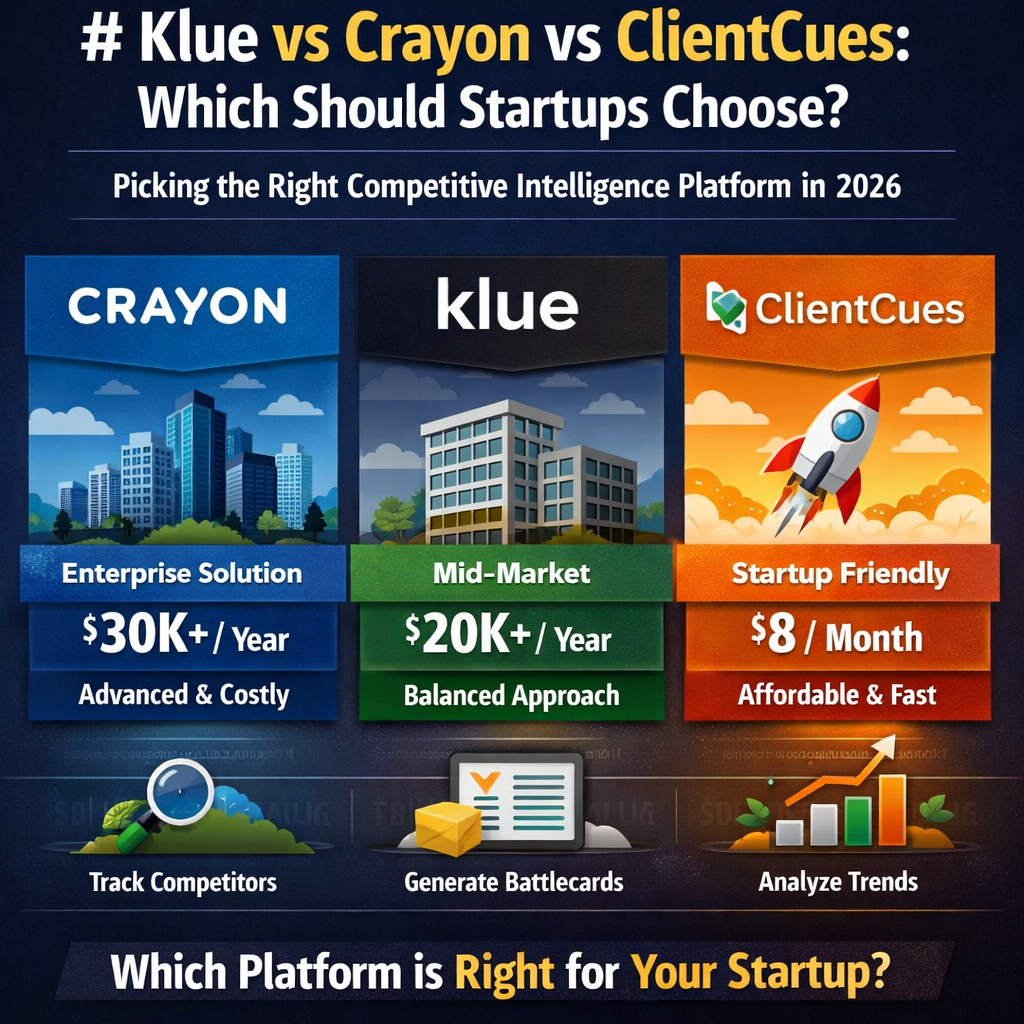
ClientCues vs Klue: The Short Answer
Klue is an enterprise competitive-enablement platform ($20,000–$40,000+ per year, 6–8 week implementation) built for dedicated product-marketing and CI teams. ClientCues is competitive intelligence built for startups — AI monitoring, weekly briefings and auto-generated battlecards from $8/month, set up in about 5 minutes. They solve the same problem for two very different kinds of companies. Here's the honest side-by-side.
ClientCues vs Klue at a Glance
| ClientCues | Klue | ||
|---|---|---|---|
| Typical annual cost | Free – $96 ($8/mo Growth) | $20,000 – $40,000+ | |
| Setup time | ~5 minutes, self-serve | 6–8 weeks, guided implementation | |
| Built for | Startups, growth-stage teams | Mid-market & enterprise | |
| Operator | Founders / PMs / marketers | Dedicated PMM or CI team | |
| Battlecards | Auto-generated, auto-updating | AI-assisted creation, curated workflows | |
| Monitoring | Websites, pricing, features, hiring, reviews, social, Reddit | News, web, social + curated sources | |
| Sales-tool delivery | Exports (PDF/PPT), alerts | Salesforce, Slack, Highspot, Seismic | |
| Enterprise SSO / CSM | Not yet | Okta/Google SSO, dedicated CSM | |
| Contract | Monthly, no annual required | Annual, sales-led |
If your evaluation is "which one can my team actually afford and run" — that single table usually decides it.
Where Klue Wins
Credit where due — Klue is the stronger choice in specific situations:
Sales enablement at scale. Klue's core loop is arming large sales teams: battlecards embedded in Salesforce, delivery into Highspot/Seismic/Showpad, and win-loss analysis feeding the cards. If you run a 50+ seat sales org with a product-marketing function, that workflow depth matters.
Enterprise procurement readiness. SSO (Okta, Google), security reviews, SLAs, and a dedicated customer success manager. If your buying process involves a security questionnaire, Klue is built for it.
A managed motion. Klue's implementation and CSM support suit organizations that want a partner operating the program with them, not just software.
Where ClientCues Wins
Time-to-value: minutes, not months. Enter your competitors' domains and ClientCues generates its first deep-scan report immediately — features, pricing, positioning, hiring signals — with no sales call and no onboarding project. Klue's 6–8 week implementation is longer than many startups' entire planning cycle.
Price that fits a startup budget. The Founder tier is free (tracks one competitor, weekly briefing included); Growth is $8/month with unlimited competitors, real-time change alerts on pricing/features/hiring/messaging, weekly AI briefings on every competitor, and unlimited exports. Klue's entry price is roughly 200x that.
Automation instead of curation. Klue assumes someone maintains the intelligence. ClientCues is autonomous: it monitors 24/7 and delivers a plain-English Monday briefing — what changed, what it means, what to do about it — plus auto-updating battlecards. Nobody on your team needs "competitive intelligence" in their job title.
Breadth per dollar. Deep-scan competitor reports, review and Reddit sentiment monitoring, session-style UX insights on competitor sites, and a built-in AI SEO toolkit (page audits, keyword gap vs competitors, backlink opportunities) — capabilities that would each be separate line items elsewhere.
Pricing Reality Check
The gap isn't subtle. Klue at $20,000–$40,000+ per year means a meaningful procurement process, budget approval, and multi-week implementation before the first insight arrives. ClientCues at $0–$96 per year means you can validate the entire product this afternoon on the free tier and upgrade when you hit its limits (1 tracked competitor, 2 deep-scan reports/month on Founder).
A useful framing: Klue is priced like headcount — justify it the way you'd justify hiring a competitive-intelligence analyst. ClientCues is priced like a utility — justify it the way you'd justify any $8 SaaS tool that saves hours weekly.
For the three-way enterprise comparison including Crayon, see Klue vs Crayon vs ClientCues.
Which Should You Choose?
Choose Klue if: you're mid-market or enterprise, sales enablement is the primary use case, you have a PMM/CI team to operate it, Salesforce integration is a hard requirement, and a $20K–$40K annual line item with a 6–8 week rollout fits your process.
Choose ClientCues if: you're a startup or growth-stage company tracking 3–10 competitors, insights need to reach founders/product/marketing/sales without an analyst in the loop, you want monitoring + briefings + battlecards running today, and your budget is startup-shaped. Start with the free tier, track your toughest competitor, and judge the Monday briefing on its own merits.
Honest edge case: if you're a startup that just raised a large round and is scaling a big sales team fast, you may genuinely outgrow ClientCues' current enterprise feature set (SSO, CSM) — many teams run ClientCues now and re-evaluate enterprise platforms at that stage. That's a reasonable path, not a failure of either tool.
Frequently Asked Questions
Is ClientCues a real alternative to Klue? For startups and growth-stage teams, yes — it covers the same core loop (monitor competitors, generate briefings, maintain battlecards) at a fraction of the price. For enterprise sales-enablement programs, Klue remains the more complete fit. See our full ClientCues alternatives breakdown for the wider market.
How much does Klue cost? Klue doesn't publish pricing; buyers typically report $20,000–$40,000+ per year on annual, sales-led contracts, varying with seats and modules.
Does ClientCues generate battlecards like Klue? Yes — battlecards are auto-generated from live competitor monitoring and update automatically as competitors change pricing, features, or messaging. Klue offers deeper manual curation and CRM-embedded delivery.
Can I try either before buying? ClientCues: yes — free tier, no sales call. Klue: demos are sales-led; there's no self-serve free tier.
Instantly compare features and user sentiment across your market. Get a competitor snapshot with real feedback and web proof—free.