Competitive Intelligence
Klue vs Crayon vs ClientCues: Which Should Startups Choose?
- Jump to section:
- Understanding Competitive Intelligence Platforms in 2026
- Crayon: The Enterprise Powerhouse
- Klue: The Mid-Market Contender
- ClientCues: The Startup-First Alternative
- Feature-by-Feature Comparison
- Pricing Comparison Table
- Making the Right Choice for Your Startup
- Real-World Scenario: A Series A SaaS Startup
- The Future of Competitive Intelligence
- Conclusion: Start Smart, Scale When Ready
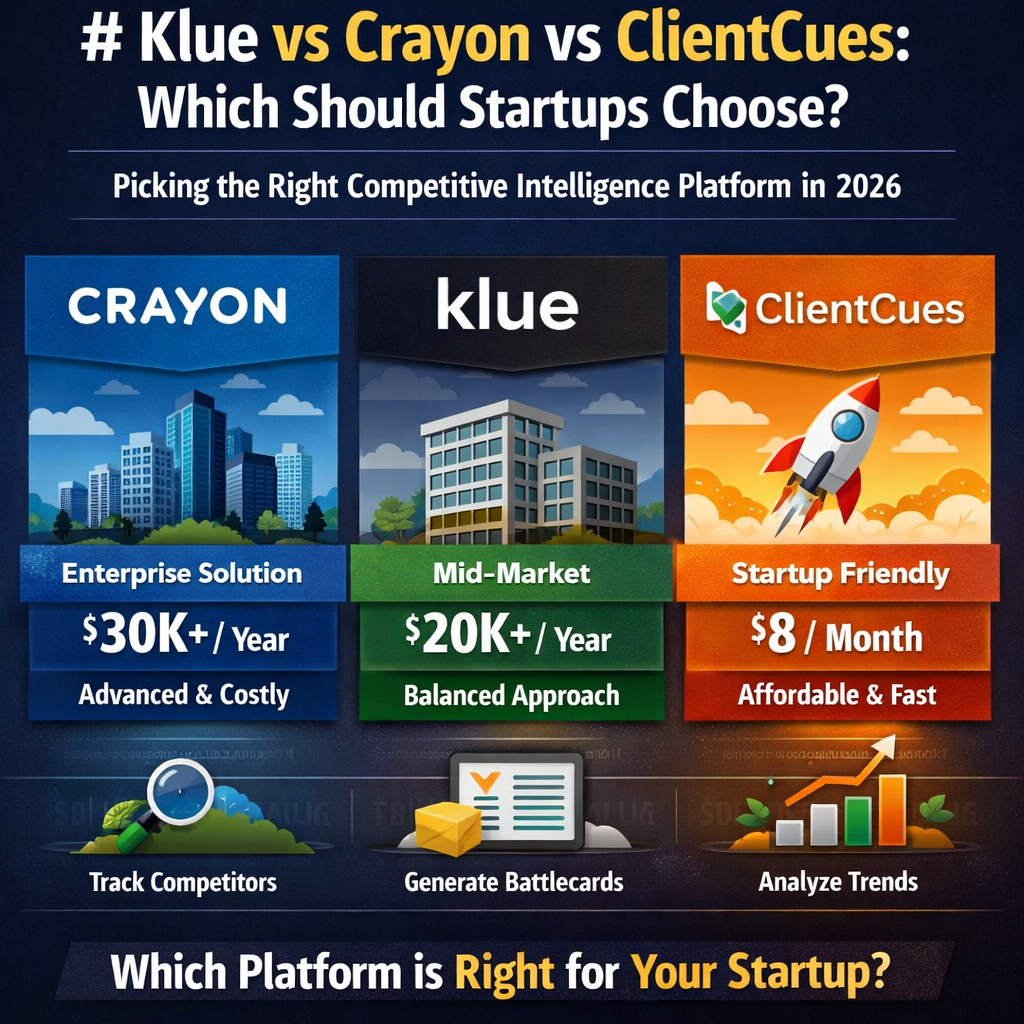
Understanding Competitive Intelligence Platforms in 2026
Choosing the right competitive intelligence platform can make or break your go-to-market strategy. In 2026, three names consistently surface in this conversation: Klue, Crayon, and ClientCues. Each promises to help you track competitors, generate battlecards, and stay ahead of market trends—but they take dramatically different approaches to pricing, features, and target audiences.
Understanding Competitive Intelligence Platforms in 2026
Competitive intelligence has evolved far beyond manual spreadsheets and quarterly competitor reviews. Modern platforms automate the collection, analysis, and distribution of competitive insights across your entire organization. They monitor competitor websites, social media, review sites, job postings, and even customer feedback channels to surface actionable intelligence in real-time.
The market has bifurcated into two distinct camps: enterprise solutions designed for Fortune 500 companies with dedicated competitive intelligence teams, and agile platforms built for startups and SMBs that need immediate insights without the overhead. Klue and Crayon dominate the enterprise segment, commanding annual contracts between $20,000 and $40,000. ClientCues represents the new wave—delivering comparable intelligence at a fraction of the cost, starting at just $8 per month.
What separates these platforms isn't just price—it's philosophy. Enterprise tools prioritize comprehensive coverage, extensive integrations, and white-glove onboarding. Startup-focused solutions emphasize speed to value, self-service setup, and pay-as-you-grow pricing. Understanding where your organization sits on this spectrum is the first step to making the right choice.
Crayon: The Enterprise Powerhouse
Crayon has established itself as the gold standard for enterprise competitive intelligence. With approximately $30,000+ in annual pricing, it's positioned squarely at large organizations with substantial budgets and complex competitive landscapes. The platform excels at aggregating data from over 100 sources, including news sites, social media, review platforms, job boards, and SEC filings.
Key Strengths: Crayon's automated capture engine continuously monitors your competitive landscape, surfacing changes within hours of publication. Their AI-powered analysis categorizes insights into predefined buckets—pricing changes, product updates, leadership moves, and market positioning shifts. The platform's battlecard builder is particularly robust, offering templates, version control, and direct integrations with Salesforce, HubSpot, and Slack.
The onboarding experience reflects Crayon's enterprise focus. Expect an 8-12 week implementation process involving dedicated customer success managers, custom training sessions, and stakeholder workshops. This isn't plug-and-play—it's a strategic initiative requiring executive buy-in and cross-functional coordination.
Ideal Use Cases: Crayon shines for enterprises with 500+ employees, multiple product lines, and global markets. If you have a dedicated competitive intelligence analyst or team, need to track 20+ competitors across various geographies, and require deep integrations with your existing tech stack, Crayon delivers exceptional value. Companies in highly regulated industries (healthcare, finance, insurance) particularly benefit from Crayon's comprehensive audit trails and compliance features.
Limitations for Startups: The $30,000+ annual commitment represents a significant barrier for early-stage companies. More critically, the platform's complexity and lengthy onboarding process conflict with startup velocity. By the time you're fully operational on Crayon, your competitive landscape may have shifted dramatically. The feature set, while comprehensive, often includes capabilities startups won't use for years—if ever.
Klue: The Mid-Market Contender
Klue positions itself between enterprise complexity and startup simplicity, targeting mid-market companies and growth-stage startups with annual pricing around $20,000-$25,000. The platform emphasizes competitive enablement—not just collecting intelligence, but ensuring sales, marketing, and product teams actually use it.
Key Strengths: Klue's standout feature is its competitive enablement workflow. The platform doesn't just generate battlecards; it tracks which ones sales reps actually access, measures win rates by competitive scenario, and identifies knowledge gaps in real-time. This feedback loop helps competitive intelligence teams prioritize their efforts based on actual revenue impact.
The AI capabilities in Klue have matured significantly in 2026. Their natural language processing engine automatically extracts key insights from lengthy competitor documents, summarizes product announcements, and even suggests talking points for sales conversations. The Chrome extension allows reps to access competitive intelligence directly within their CRM, reducing context-switching and increasing adoption.
Klue's onboarding is more streamlined than Crayon's—typically 4-6 weeks—but still requires dedicated resources. The platform offers more flexibility in customization, allowing teams to define their own intelligence categories, create custom battlecard templates, and build unique competitor profiles tailored to their specific market.
Ideal Use Cases: Klue works best for companies with 100-500 employees that have established product-market fit and are scaling their sales organization. If you're hiring multiple account executives, expanding into new markets, or facing increasingly complex competitive scenarios, Klue provides the structure and enablement tools to keep everyone aligned. B2B SaaS companies with longer sales cycles (3+ months) particularly benefit from Klue's deal-specific intelligence features.
Limitations for Startups: While more accessible than Crayon, Klue's $20,000+ annual cost still represents a substantial investment for pre-Series A startups. The platform assumes you have dedicated personnel to manage competitive intelligence—whether a full-time analyst or a product marketer wearing multiple hats. For teams under 20 people, the ROI calculation becomes challenging. You're paying for enablement infrastructure before you have a large enough team to enable.
ClientCues: The Startup-First Alternative
ClientCues takes a fundamentally different approach to competitive intelligence. Rather than building for enterprise complexity, it's designed for startup velocity—delivering immediate insights at a price point that makes sense from day one. At $8 per month (with a functional free tier), ClientCues removes the financial barrier entirely, letting founders and small teams access competitive intelligence previously reserved for companies with massive budgets.
Key Strengths: The platform's defining characteristic is speed to value. There's no onboarding process, no implementation timeline, no training required. Enter a competitor's domain, and within minutes, you receive a comprehensive report covering their positioning, features, customer sentiment, and recent changes. This instant gratification aligns perfectly with startup decision-making cycles, where waiting 8 weeks for intelligence is simply not an option.
ClientCues leverages advanced AI to automate what enterprise platforms require human analysts to configure. The system automatically discovers your competitors, identifies relevant feedback channels (Reddit, review sites, social media), extracts key topics and sentiment, and generates weekly briefings without manual setup. For a solo founder or lean product team, this automation is transformative—you get enterprise-grade insights without enterprise-grade overhead.
The battlecard generation, while simpler than Klue's or Crayon's, covers the essential elements: feature comparisons, pricing intelligence, customer sentiment, and competitive positioning. More importantly, these battlecards are automatically updated as new intelligence surfaces, eliminating the manual refresh cycle that plagues enterprise platforms.
Ideal Use Cases: ClientCues is purpose-built for startups from pre-seed through Series B, solo founders conducting market research, product managers at early-stage companies, and growth teams at bootstrapped businesses. If you need to understand your competitive landscape quickly, track 3-10 competitors continuously, and make data-driven positioning decisions without breaking the bank, ClientCues delivers exactly what you need—nothing more, nothing less.
The platform also excels for consultants, agencies, and fractional executives who need to quickly ramp up on new markets. The ability to generate unlimited reports at $8/month makes ClientCues a no-brainer for anyone conducting frequent competitive analyses across multiple clients or industries.
Scaling Considerations: The question every startup asks: "Will I outgrow this?" ClientCues scales with your usage rather than forcing you into rigid tiers. As you track more competitors, analyze more feedback channels, and generate more reports, the platform accommodates that growth without requiring enterprise contracts. However, companies reaching 200+ employees with dedicated competitive intelligence teams may eventually need the advanced workflow management, custom integrations, and white-glove support that enterprise platforms provide. By that point, you've likely raised significant funding and can justify the upgrade.
Feature-by-Feature Comparison
Competitor Monitoring: Crayon monitors 100+ sources with the most comprehensive coverage, ideal for tracking competitors across global markets and multiple languages. Klue focuses on 50+ high-impact sources with better signal-to-noise ratio, reducing information overload. ClientCues monitors essential sources (websites, social media, Reddit, review sites) with AI-powered prioritization that surfaces only significant changes, perfect for teams that need insights without drowning in data.
Battlecard Generation: Crayon offers the most sophisticated battlecard builder with advanced templates, version control, approval workflows, and deep CRM integration. Klue provides competitive battlecards with usage analytics, showing which cards drive wins and which need updating. ClientCues delivers auto-generated, continuously updated battlecards covering core competitive elements—simpler but sufficient for most startup sales scenarios.
AI and Automation: All three platforms leverage AI, but differently. Crayon uses AI for categorization and insight extraction across massive data volumes. Klue applies AI to summarization, insight generation, and competitive scenario matching. ClientCues employs AI for automatic competitor discovery, sentiment analysis, topic extraction, and report generation—maximizing automation to minimize manual work for small teams.
Alert Systems: Crayon delivers highly configurable alerts with granular filtering, custom rules, and multi-channel distribution (email, Slack, Teams). Klue provides contextual alerts tied to deals and competitive scenarios, ensuring reps get relevant intelligence when they need it. ClientCues sends weekly automated briefings summarizing key changes across all tracked competitors, balancing timeliness with digestibility.
Onboarding and Time to Value: This is where differences become stark. Crayon requires 8-12 weeks with dedicated implementation resources. Klue needs 4-6 weeks with guided setup and training. ClientCues delivers value in under 5 minutes with zero onboarding—enter a competitor, get insights immediately. For startups operating on compressed timelines, this difference is often decisive.
Integration Ecosystem: Crayon and Klue both offer extensive integrations with Salesforce, HubSpot, Slack, Microsoft Teams, and various marketing automation platforms. ClientCues focuses on export flexibility (PDF, PPT) rather than deep integrations, acknowledging that early-stage companies often lack complex tech stacks. As your stack matures, you can export ClientCues insights into whatever tools you're using.
Pricing Comparison Table
| Feature | Crayon | Klue | ClientCues | |
|---|---|---|---|---|
| Annual Cost | ~$30,000+ | ~$20,000-$25,000 | $0-$96/year | |
| Monthly Cost | ~$2,500+ | ~$1,667-$2,083 | $0-$8 | |
| Setup Fee | Often included | Often included | $0 | |
| Contract Length | 12 months minimum | 12 months minimum | Month-to-month | |
| Onboarding Time | 8-12 weeks | 4-6 weeks | <5 minutes | |
| Free Trial | Demo only | Limited trial | Full-featured free tier | |
| Competitors Tracked | Unlimited | Unlimited | 1 (free) / Unlimited ($8) | |
| Users Included | 10-25+ | 5-15+ | Unlimited | |
| Data Sources | 100+ | 50+ | 20+ essential | |
| Battlecards | Advanced | Advanced | Auto-generated | |
| CRM Integration | Deep | Deep | Export-based | |
| AI Analysis | Yes | Yes | Yes (automated) | |
| Best For | Enterprise (500+) | Mid-market (100-500) | Startups (1-200) |
Making the Right Choice for Your Startup
The decision ultimately comes down to three factors: budget, team size, and competitive complexity. If you're a startup with limited runway, choosing a $20,000-$30,000 annual platform is a strategic bet that needs to pay off quickly. That investment could instead fund a full-time employee, significant ad spend, or critical infrastructure. The opportunity cost is real.
Choose Crayon if: You're a well-funded growth-stage company (Series C+) with 500+ employees, a dedicated competitive intelligence team, complex global competition, and the budget to support a comprehensive enterprise solution. You need deep integrations, extensive customization, and white-glove support. Your competitive intelligence function is mature and strategic, not tactical.
Choose Klue if: You're a mid-market company or well-funded Series B startup with 100-500 employees, an established sales organization, and the need for competitive enablement at scale. You have someone (or a small team) who can own competitive intelligence as a significant part of their role. Your sales cycles are complex enough that deal-specific competitive insights drive measurable revenue impact.
Choose ClientCues if: You're a startup (pre-seed through Series B) with under 200 employees, limited budget for competitive intelligence, and the need for immediate insights without lengthy implementation. You don't have dedicated competitive intelligence resources and need a solution that delivers value autonomously. You value speed, simplicity, and flexibility over comprehensive enterprise features you won't use for years.
For most startups reading this article, ClientCues represents the logical choice. The $8 monthly investment is essentially risk-free—less than a single team lunch. The instant setup means you can start tracking competitors today, not in two months. And the AI-powered automation ensures you get continuous intelligence without dedicating human resources to platform management.
Real-World Scenario: A Series A SaaS Startup
Consider a typical Series A SaaS company: 25 employees, $3M in ARR, $8M raised, and 18-month runway. They're competing against 5-7 direct competitors and need to understand positioning, feature gaps, and customer sentiment to inform their product roadmap and sales strategy.
With Crayon: They'd spend $30,000 (nearly 1% of their annual budget), dedicate 2-3 months to implementation, and assign a product marketer to manage the platform part-time. The comprehensive data would be impressive, but they'd use perhaps 30% of the features. The annual contract creates financial rigidity just when they need flexibility most.
With Klue: They'd invest $20,000 (more palatable but still significant), complete setup in 4-6 weeks, and get better competitive enablement for their growing sales team. This makes more sense if they're actively hiring AEs and facing complex competitive deals. However, the annual commitment still represents a substantial bet on a single vendor.
With ClientCues: They'd pay $96 annually (or start free and upgrade when ready), begin tracking competitors immediately, and receive weekly automated briefings covering all essential intelligence. The product marketer can focus on strategy and execution rather than platform management. If the company's needs evolve, they can cancel or upgrade without penalty. The financial risk is negligible, and the time to value is immediate.
In this scenario, ClientCues delivers 80% of the value at 0.3% of the cost. For a startup optimizing for capital efficiency and speed, that math is compelling. The money saved can fund growth experiments, product development, or additional runway—all likely to generate better returns than marginal competitive intelligence features.
The Future of Competitive Intelligence
As we move through 2026, competitive intelligence is democratizing. AI and automation are eliminating the manual work that previously justified enterprise pricing. Startups no longer need to choose between competitive blindness and budget-breaking platforms. Tools like ClientCues prove that sophisticated intelligence can be accessible, affordable, and automatic.
The enterprise platforms aren't going anywhere—they serve a legitimate need for large organizations with complex requirements. But for the vast majority of startups and SMBs, the future looks more like ClientCues: instant insights, AI-powered automation, and pricing that scales with your growth rather than forcing premature commitments.
Conclusion: Start Smart, Scale When Ready
Competitive intelligence shouldn't be a luxury reserved for well-funded enterprises. Every startup deserves to understand their competitive landscape, track market trends, and make informed strategic decisions. The question isn't whether you need competitive intelligence—it's whether you need enterprise features at enterprise prices.
For most startups, the answer is no. Start with ClientCues at $8/month (or free), get immediate value, and track your competitors without the overhead. As you scale to hundreds of employees with dedicated competitive intelligence teams, you can graduate to enterprise platforms if needed. But don't pay for enterprise features before you have an enterprise.
The smartest competitive intelligence strategy is the one you'll actually use. A simple, affordable platform that delivers daily insights beats a sophisticated, expensive platform that takes months to implement and requires dedicated resources to manage. Start smart. Scale when ready. Stay competitive from day one.
Ready to understand your competitive landscape without the enterprise price tag? Run a free competitor analysis at clientcues.com and see what your competitors are doing—in minutes, not months. No credit card required. No lengthy onboarding. Just instant, actionable intelligence to help you compete smarter.
Instantly compare features and user sentiment across your market. Get a competitor snapshot with real feedback and web proof—free.