Competitive Intelligence
ClientCues Alternatives (2026): An Honest Comparison
- Jump to section:
- Quick Verdict: The Best ClientCues Alternatives at a Glance
- Why Teams Look for ClientCues Alternatives
- How to Choose the Right Competitive Intelligence Tool
- The Alternatives in Detail
- Pricing and Setup Comparison Table
- Where ClientCues Fits (and Where It Doesn't)
- Frequently Asked Questions
Looking for ClientCues Alternatives? Start Here
If you're evaluating ClientCues and want to see what else is out there, this page is the honest version of that research. We build ClientCues, so we know exactly where it shines and where another tool might genuinely serve you better. Below: the quick verdict, the real alternatives — Klue, Crayon, Kompyte, Semrush CI, and Owler — and a plain comparison of pricing, setup time, and what each tool is actually for.
Quick Verdict: The Best ClientCues Alternatives at a Glance
Short on time? Here's the honest summary:
| If you need... | Best choice | Why | |
|---|---|---|---|
| Enterprise sales enablement with a dedicated CI team | Klue | Deep battlecard workflows, Salesforce integration, CSM support | |
| Enterprise CI with analyst services | Crayon | Broadest enterprise monitoring, mature platform | |
| Marketing-focused digital tracking | Kompyte (Semrush) | Ads, SEO and content tracking in the Semrush ecosystem | |
| SEO-first competitor data, already on Semrush | Semrush CI | Traffic analytics and content gaps inside your existing plan | |
| Free news alerts, zero budget | Owler | Basic news aggregation at $0 | |
| Full CI on a startup budget, set up in minutes | ClientCues | AI monitoring, weekly briefings and auto-battlecards from $8/month |
The pattern is simple: the enterprise platforms (Klue, Crayon) win when you have a dedicated competitive-intelligence function and a five-figure budget. ClientCues wins when you don't. The marketing tools (Kompyte, Semrush) solve a narrower, channel-specific problem.
Why Teams Look for ClientCues Alternatives
Being honest about our own limitations builds more trust than pretending we're perfect for everyone. Teams typically evaluate alternatives to ClientCues for four reasons:
You need enterprise procurement features. ClientCues doesn't yet offer enterprise SSO (Okta/SAML), custom security reviews, or dedicated customer success managers. If your security team requires a vendor questionnaire and an SLA, Klue and Crayon are built for that buying process.
You track dozens of competitors across multiple business units. ClientCues is designed for startups tracking roughly 3–10 direct competitors deeply. If you're a large organization tracking 50+ companies across several product lines with a dedicated analyst team, an enterprise platform's workflow tooling will fit better.
Your CI need is actually a marketing-channel need. If what you really want is competitor ad tracking, SEO position monitoring, and content gap analysis — and nothing else — a marketing-specific tool like Kompyte or Semrush's competitive toolkit may match the job more precisely.
You want a managed service, not a product. Some teams want analysts curating intelligence for them. Crayon and Klue offer service layers; ClientCues is deliberately self-serve and automated.
How to Choose the Right Competitive Intelligence Tool
Before comparing vendors feature-by-feature, answer three questions — they eliminate most of the market instantly:
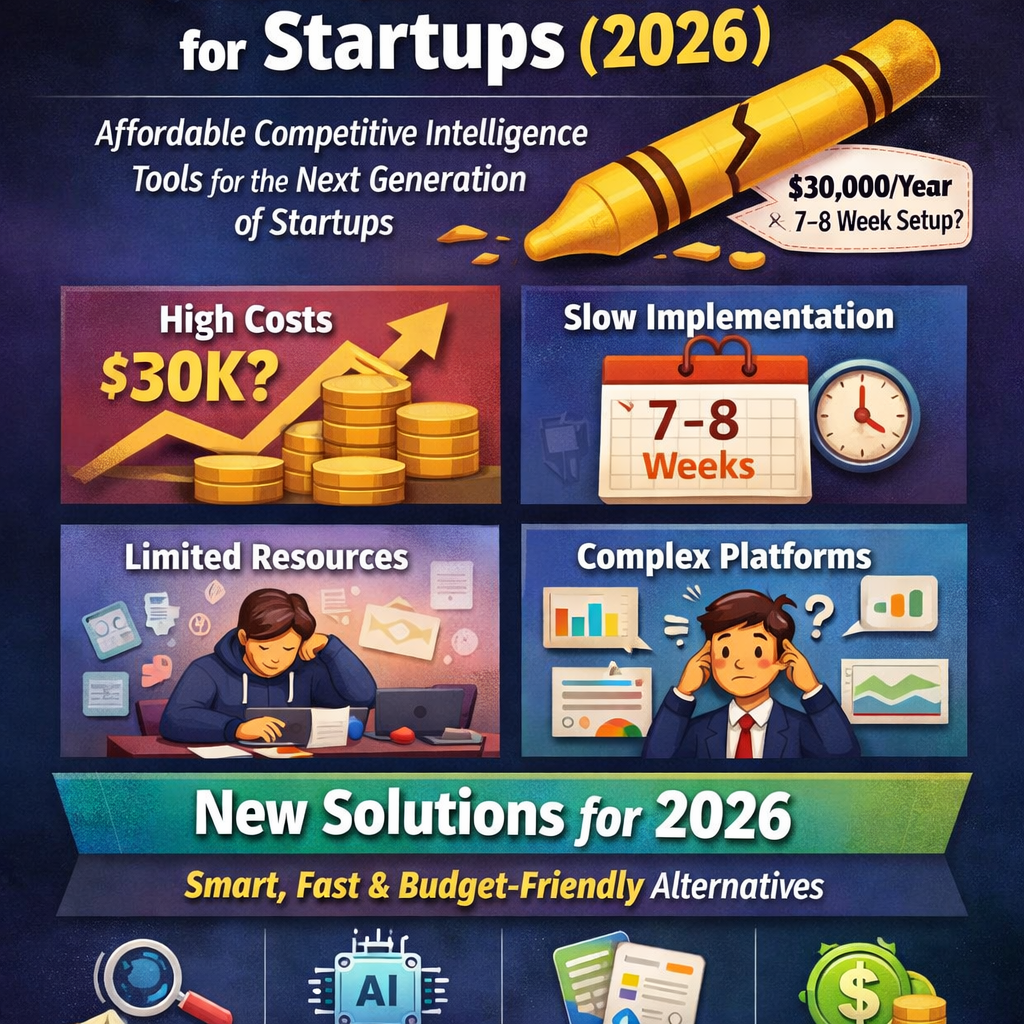
1. What's your realistic annual budget? Enterprise CI platforms start around $20,000–$30,000 per year. If that's more than you'll spend, your real choice set is ClientCues, Semrush CI, or Owler.
2. Who will operate the tool? If the answer is "a product manager or founder with five other jobs," you need automation-first tooling that produces finished briefings and battlecards — not a workbench that needs an analyst.
3. How fast do you need value? Enterprise implementations run 6–8 weeks. ClientCues generates its first competitor report in about 5 minutes; Semrush CI configures in hours. Match the tool's time-to-value to your operating tempo.
The Alternatives in Detail
Klue — the enterprise sales-enablement alternative. Pricing typically runs $20,000–$40,000+ per year with a 6–8 week implementation. Klue's strength is turning competitive intelligence into sales outcomes: battlecards maintained inside your CRM workflow, win-loss analysis, and delivery into Salesforce, Slack, and enablement platforms like Highspot and Seismic. Choose Klue if sales enablement is your primary CI use case and you have a product-marketing team to run it. It's out of reach for most startup budgets, and you won't see value until implementation completes.
Crayon — the enterprise monitoring alternative. Crayon starts around $30,000 per year with a 7–8 week implementation. It offers the broadest monitoring surface of the enterprise tools — websites, news, reviews, social — plus battlecards and analyst-grade reporting. Choose Crayon if you're an enterprise with a dedicated CI analyst and need maximum source coverage. For a detailed cost breakdown, see our Crayon pricing analysis.
Kompyte (by Semrush) — the marketing-tracking alternative. Estimated $10,000–$25,000 per year, 3–4 week setup. Kompyte automates tracking of competitor websites, ads, SEO changes, and social activity, and it's now part of the Semrush ecosystem. Choose it if your CI need is fundamentally a digital-marketing need. Product and sales teams usually find it less useful than dedicated CI platforms.
Semrush Competitive Intelligence Toolkit — the SEO-suite alternative. $119–$449/month as part of a Semrush subscription. If you already pay for Semrush, its CI add-ons (traffic analytics, keyword gap, backlink comparison) are good value for marketing questions. It won't tell you a competitor changed their pricing page or launched a feature — it's marketing telemetry, not strategic intelligence.
Owler — the free news-alerts alternative. Free tier, Pro at about $420/year. Owler aggregates funding news, executive changes, and company updates. It's a reasonable supplement at zero budget, but it's news aggregation — no analysis, no battlecards, no monitoring of pricing or feature pages.
Pricing and Setup Comparison Table
| Tool | Typical annual cost | Setup time | Built for | |
|---|---|---|---|---|
| ClientCues | Free – $96 ($8/month Growth) | ~5 minutes | Startups tracking 3–10 competitors without a dedicated analyst | |
| Klue | $20,000 – $40,000+ | 6–8 weeks | Enterprise sales enablement with a PMM/CI team | |
| Crayon | ~$30,000+ | 7–8 weeks | Enterprise CI with dedicated analysts | |
| Kompyte | $10,000 – $25,000 (est.) | 3–4 weeks | Marketing-focused competitor tracking | |
| Semrush CI | $1,428 – $5,388 | 1–2 hours | Marketing teams already on Semrush | |
| Owler | Free – $420 | 15 minutes | News alerts on zero budget |
Prices reflect publicly discussed ranges as of early 2026; enterprise contracts vary by seats and scope — always confirm with the vendor.
Where ClientCues Fits (and Where It Doesn't)
ClientCues is the right call when: you're a B2B startup or growth-stage team; the people consuming competitive intelligence are founders, PMs, marketers and sellers rather than dedicated analysts; you want monitoring across competitor websites, reviews, social and hiring with plain-English weekly briefings, real-time change alerts, and auto-generated battlecards; and you want all of that at $8/month with a free tier — set up before your next meeting. You can see exactly how it compares in our live competitor comparisons.
ClientCues is the wrong call when: you need enterprise SSO and procurement processes today, you track 50+ competitors with a dedicated team, or you want a managed analyst service. In those cases, start your evaluation with Klue and Crayon — genuinely.
The fastest way to decide: run the free tier against your top competitor this week, and compare the briefing you get against what you're producing manually today.
Frequently Asked Questions
What is the best ClientCues alternative for enterprises? Klue and Crayon. Both are built for enterprise procurement, dedicated CI teams, and sales-enablement workflows, with pricing typically starting around $20,000–$30,000 per year.
What is the cheapest alternative to ClientCues? Owler's free tier, for basic company news alerts. For actual monitoring and analysis on a small budget, ClientCues' own free Founder tier tracks one competitor with weekly briefings.
Is ClientCues a Crayon alternative or the other way around? Both, depending on your size. Enterprises evaluating down-market land on ClientCues to cut cost; startups priced out of Crayon's ~$30K/year contracts use ClientCues to get the same core intelligence loop — monitoring, briefings, battlecards — at startup pricing.
Can I migrate from an enterprise CI tool to ClientCues? Yes — setup takes minutes: add your competitors' domains and ClientCues generates its first deep-scan report immediately. There's no data migration because the intelligence is regenerated from live sources.
Instantly compare features and user sentiment across your market. Get a competitor snapshot with real feedback and web proof—free.