Competitive Intelligence
Crayon Pricing: Is It Worth $30K/Year?
- Jump to section:
- What Crayon Includes at the Enterprise Price Point
- Crayon Competitive Intelligence Pricing Plans: What Buyers Should Know
- Who Actually Needs Enterprise Competitive Intelligence?
- Feature-by-Feature Comparison: Crayon vs ClientCues
- When Crayon Makes Sense vs When It's Overkill
- ROI Analysis: Breaking Down the Real Costs
- Making the Right Choice for Your Organization
- Get 80% of Crayon for 5% of the Price — Try ClientCues Free
What Crayon Includes at the Enterprise Price Point
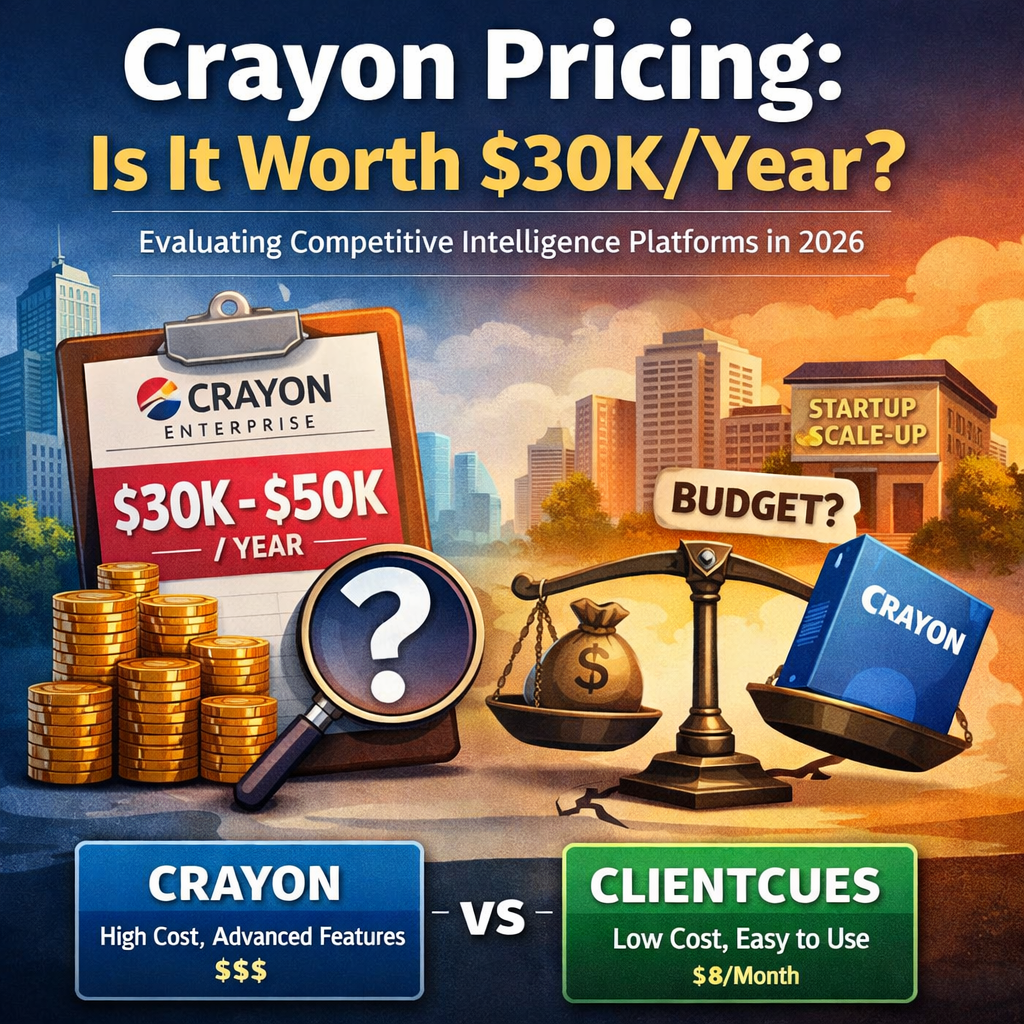
When evaluating competitive intelligence platforms in 2026, one question dominates budget discussions: Is Crayon's enterprise pricing—typically ranging from $30,000 to $50,000 annually—justified for your organization? For Fortune 500 companies with dedicated competitive intelligence teams, the answer might be yes. But for the vast majority of startups, scale-ups, and mid-market companies, there's a significant value gap that deserves careful examination.
What Crayon Includes at the Enterprise Price Point
Crayon positions itself as the premium solution for enterprise competitive intelligence, and at $30,000+ per year (often closer to $40,000-$50,000 for full implementations), it delivers a comprehensive suite of features designed for large-scale operations. The platform's core offering includes automated competitive tracking across multiple channels—websites, social media, job postings, patent filings, and news sources—aggregating these signals into a centralized intelligence hub.
The enterprise package typically includes battlecard creation and management tools, which allow sales enablement teams to generate competitive positioning documents that reps can access during deals. Crayon's AI-powered analysis engine processes this incoming data to identify trends, competitive moves, and market shifts, theoretically saving analysts hours of manual research time. The platform also offers Slack and Microsoft Teams integrations, allowing competitive updates to flow directly into your team's existing workflows.
Additionally, Crayon provides dedicated customer success management, which includes an 8-12 week implementation process, ongoing training sessions, and strategic consulting on competitive intelligence best practices. This white-glove service is particularly valuable for organizations building their first formal competitive intelligence function and needing guidance on program structure, stakeholder engagement, and measurement frameworks.
However, it's important to note what's often not included in the base price. Advanced features like custom integrations with your CRM or product management tools, additional user seats beyond a certain threshold, and premium support packages frequently come with additional costs. Many organizations report that their true annual spend on Crayon exceeds the initial quote by 20-30% once these add-ons are factored in.
Crayon Competitive Intelligence Pricing Plans: What Buyers Should Know
Searching for Crayon competitive intelligence pricing rarely gives a straight answer, because Crayon doesn't publish pricing plans — every contract is sales-led and quoted per organization. Based on buyer-reported figures, here's the realistic picture of Crayon's competitive intelligence pricing in 2026:
| Crayon pricing component | Typical range | Notes | |
|---|---|---|---|
| Base annual platform fee | $30,000 – $50,000 | Varies with company size and modules | |
| Implementation | Included, 7–8+ weeks | White-glove onboarding and training | |
| Extra seats / add-ons | +20–30% over quote | CRM integrations, premium support | |
| Contract terms | Annual, sales-led | No monthly or self-serve option |
Key takeaways on Crayon's pricing plans: there is no free tier or trial-to-paid path — evaluation happens through sales demos; the total cost of ownership typically lands 20–30% above the initial quote once add-ons are included; and value depends heavily on having a dedicated person operating the platform. If those plans fit your budget and team structure, Crayon is a strong enterprise product. If they don't, the comparison below shows what the same core intelligence loop costs at startup pricing.
Who Actually Needs Enterprise Competitive Intelligence?
Understanding who benefits most from enterprise-grade competitive intelligence platforms is essential before committing to a five-figure annual investment. Crayon and similar enterprise solutions are genuinely designed for specific organizational profiles, and recognizing whether your company fits these criteria can save significant budget and implementation headaches.
Large enterprises with dedicated competitive intelligence teams of 3+ full-time analysts are the sweet spot for Crayon's offering. These organizations typically operate in highly competitive markets where missing a competitor's product launch, pricing change, or strategic pivot could result in lost deals worth millions. They need robust workflow management, role-based access controls, and the ability to coordinate intelligence gathering across multiple business units and geographic regions.
Companies in heavily regulated industries—such as financial services, healthcare, or government contracting—often require the enterprise-grade security, compliance certifications, and audit trails that platforms like Crayon provide. The ability to demonstrate data governance, maintain detailed user activity logs, and ensure SOC 2 compliance justifies the premium pricing for these organizations.
Sales-driven organizations with 100+ quota-carrying reps also represent ideal Crayon customers. When you're enabling a large sales force with competitive intelligence, the battlecard distribution system, usage analytics, and integration with sales enablement platforms become critical. The ROI calculation changes significantly when you're trying to influence hundreds of competitive deals simultaneously rather than a handful per quarter.
Conversely, startups with fewer than 50 employees, product-led growth companies where sales plays a smaller role, and organizations without a dedicated competitive intelligence budget owner rarely extract sufficient value from enterprise platforms. For these teams, the complexity, implementation timeline, and cost structure create more friction than value—they need competitive intelligence that's immediate, actionable, and doesn't require a multi-week onboarding process.
Feature-by-Feature Comparison: Crayon vs ClientCues
To truly evaluate whether Crayon's pricing is justified, we need to examine what you're actually getting compared to more affordable alternatives. Here's a detailed feature comparison between Crayon at ~$30,000/year and ClientCues at $8/month ($96/year):
Competitive Monitoring & Data Collection:
Analysis & Intelligence Generation:
Battlecards & Sales Enablement:
Reporting & Sharing:
Implementation & Time to Value:
Pricing & Accessibility:
- Crayon: Tracks 100+ data sources including websites, social media, job boards, patent databases, news outlets, and earnings calls. Automated daily scans with customizable tracking parameters.
- ClientCues: Monitors competitor websites, Reddit discussions, review sites (G2, Capterra, Trustpilot), social proof, and customer sentiment. Weekly automated briefings with unlimited competitor tracking.
- Verdict: Crayon offers broader source coverage, but ClientCues captures the most actionable signals—actual customer feedback and sentiment—that directly inform product and positioning decisions.
- Crayon: AI-powered trend detection, competitive move identification, and strategic insight generation. Requires analyst interpretation and synthesis.
- ClientCues: Advanced AI topic analysis and sentiment scoring on customer feedback. Auto-generated competitive reports with web proof and real user sentiment. Instant market intelligence reports comparing features and positioning.
- Verdict: Both leverage AI effectively, but ClientCues focuses on immediately actionable insights rather than raw data aggregation that still requires significant analyst time.
- Crayon: Sophisticated battlecard builder with templates, version control, and distribution tracking. Integration with sales enablement platforms. Usage analytics showing which reps access which cards.
- ClientCues: Auto-generated battlecards based on competitive analysis. Exportable as PDF or PPT for easy sharing with sales teams.
- Verdict: Crayon wins for large sales organizations needing granular control and analytics. ClientCues provides the essential functionality without the complexity.
- Crayon: Custom dashboards, scheduled reports, executive summaries. Requires configuration and ongoing maintenance.
- ClientCues: Unlimited report exports (PDF, PPT), edit-before-export capability, personalized weekly briefings. Ready to share in one click.
- Verdict: ClientCues delivers faster time-to-value with pre-built, immediately shareable reports. Crayon offers more customization for specific enterprise workflows.
- Crayon: 8-12 week implementation with dedicated customer success manager. Requires internal stakeholder alignment, data source configuration, and team training.
- ClientCues: Start in 5 minutes. Enter competitor names, get instant reports. No implementation required.
- Verdict: For organizations needing immediate intelligence, ClientCues' instant setup is transformative. Crayon's implementation makes sense only if you're building a long-term CI program.
- Crayon: $30,000-$50,000/year with annual contracts. Additional costs for extra users, integrations, and premium support.
- ClientCues: $8/month ($96/year) with no annual contract. Cancel anytime. Free tier available for solo founders.
- Verdict: ClientCues costs approximately 0.3% of Crayon's price while delivering 70-80% of the core functionality most teams actually use.
When Crayon Makes Sense vs When It's Overkill
Making the right platform choice requires honest assessment of your organization's maturity, resources, and competitive intelligence needs. Let's examine specific scenarios where Crayon's enterprise pricing is justified versus situations where it represents significant overkill.
Crayon Makes Sense When:
Your company has annual revenue exceeding $100M and competitive intelligence directly influences deals worth millions. In these scenarios, even a 1-2% improvement in win rates easily justifies the investment. If your average deal size is $500K and you close 100 competitive deals annually, improving your win rate from 40% to 42% generates $1M in additional revenue—a 33x ROI on a $30K platform investment.
You have 3+ people working full-time on competitive intelligence who need collaboration tools, workflow management, and role-based access. Enterprise platforms excel at coordinating team efforts, preventing duplicate work, and maintaining institutional knowledge as team members change. The cost per user at this scale becomes reasonable when you factor in the productivity gains.
Your industry requires extensive compliance documentation, security certifications (SOC 2 Type II, ISO 27001), and detailed audit trails. Financial services, healthcare, and government contractors often can't use lightweight tools regardless of functionality—procurement requirements mandate enterprise-grade security and support SLAs that only platforms like Crayon provide.
You're operating in a market with 20+ significant competitors where missing a single product launch or pricing change could cost millions in lost positioning. The breadth of Crayon's monitoring—tracking patent filings, job postings, and earnings calls—provides early warning signals that more focused tools might miss.
Crayon Is Overkill When:
You're a startup or scale-up with fewer than 100 employees and limited competitive intelligence budget. The implementation timeline alone (8-12 weeks) exceeds the planning horizon of many early-stage companies. By the time Crayon is fully configured, your competitive landscape may have shifted entirely.
Your primary need is understanding what customers actually think about your competitors' products. If you're a product manager trying to identify feature gaps or a marketer crafting positioning, you need customer sentiment and feedback analysis more than patent tracking and earnings call summaries. ClientCues' focus on real user sentiment delivers more actionable product and marketing insights.
You don't have a dedicated competitive intelligence analyst who can manage the platform, interpret the data, and distribute insights across the organization. Enterprise CI tools require ongoing attention—someone needs to configure alerts, maintain battlecards, and synthesize raw data into strategic recommendations. Without this dedicated resource, you're paying for a Ferrari but have no one to drive it.
Your sales cycle is primarily product-led or self-service, with limited head-to-head competitive evaluations. Companies where customers discover, evaluate, and purchase independently don't benefit from sophisticated sales battlecards and competitive positioning tools. The ROI simply isn't there when you're not in regular competitive sales situations.
You need immediate competitive intelligence to inform a product launch, fundraising pitch, or strategic planning session happening in the next 2-4 weeks. Crayon's implementation timeline makes it impossible to extract value quickly. Tools like ClientCues that provide instant insights are better suited for time-sensitive competitive intelligence needs.
ROI Analysis: Breaking Down the Real Costs
Understanding the true return on investment for competitive intelligence platforms requires looking beyond the sticker price to examine total cost of ownership, opportunity costs, and the actual business value generated. Let's analyze the complete financial picture for both Crayon and ClientCues.
Crayon Total Cost of Ownership (Annual):
For this investment to generate positive ROI, you need to demonstrate measurable business impact. If you're a $50M ARR company growing at 30% annually, you'd need to attribute approximately 0.2-0.3% of that growth to improved competitive intelligence to break even. That's roughly $100K-$150K in additional revenue or retained customers that wouldn't have been won without Crayon's insights.
For large enterprises closing million-dollar deals, this bar is easily cleared. Winning just one additional competitive deal per year that you would have otherwise lost justifies the entire investment. However, for companies with smaller deal sizes or fewer competitive situations, the math becomes challenging. A $10M ARR SaaS company with $50K average contract values needs to win 2-3 additional deals directly attributable to better competitive intelligence—a difficult causal relationship to prove.
ClientCues Total Cost of Ownership (Annual):
The ROI threshold for ClientCues is dramatically lower. For a $5,000 annual investment to break even, you need to generate just $5,000 in additional value—perhaps by identifying a critical feature gap that prevents a single churn, informing a positioning change that improves conversion by 0.1%, or avoiding a pricing mistake by understanding competitor moves. These micro-wins are far easier to achieve and attribute than the macro-level impact required to justify Crayon.
The Value Gap Analysis:
Here's the crucial insight: ClientCues delivers approximately 70-80% of the functionality that most product, marketing, and sales teams actually use from enterprise CI platforms at 5% of the cost. The 20-30% of advanced features you're not getting—extensive data source coverage, sophisticated workflow management, enterprise security certifications—are only valuable if you're specifically structured to leverage them.
For a Series A startup with 30 employees, paying $30K for Crayon means you're essentially paying $1,000 per employee for competitive intelligence. That same startup using ClientCues at $96/year pays $3.20 per employee—a 300x difference in per-employee cost for similar core functionality.
The opportunity cost is equally significant. That $30K not spent on Crayon could fund a junior product marketing manager for 3-4 months, additional customer research, or expanded product development. For resource-constrained startups, allocating budget to areas with more direct impact on growth often generates superior returns.
- Platform subscription: $30,000-$50,000
- Implementation and training (often one-time but amortized): $10,000-$15,000
- Dedicated analyst to manage platform (50% of time): $40,000-$50,000 (50% of $80K-$100K salary)
- Additional integrations and premium features: $5,000-$10,000
- Total Year 1: $85,000-$125,000
- Total Year 2+: $75,000-$110,000 annually
- Platform subscription: $96/year ($8/month)
- Implementation and training: $0 (instant setup)
- Analyst time to manage platform (5% of time): $4,000-$5,000
- Additional costs: $0 (all features included)
- Total Year 1: ~$5,000
- Total Year 2+: ~$5,000 annually
Making the Right Choice for Your Organization
The decision between enterprise competitive intelligence platforms like Crayon and accessible alternatives like ClientCues ultimately comes down to organizational fit, not feature checklists. Both tools serve legitimate purposes for different company profiles, and choosing wisely can mean the difference between competitive intelligence that transforms your business and an expensive shelfware subscription.
If you're a large enterprise with dedicated competitive intelligence resources, complex compliance requirements, and the need to coordinate intelligence across multiple teams and geographies, Crayon's enterprise pricing may be justified. The platform's sophisticated workflow management, extensive data source coverage, and white-glove implementation support are designed for your use case. You have the team capacity to maximize the platform's potential and the deal sizes to justify the investment through measurable win rate improvements.
However, if you're a startup, scale-up, or mid-market company where competitive intelligence is distributed across product managers, marketers, and sales leaders rather than owned by a dedicated team, the value equation shifts dramatically. You need tools that provide immediate insights without lengthy implementations, capture the signals that actually inform product and positioning decisions (customer feedback and sentiment), and don't require significant ongoing management overhead.
For these organizations, ClientCues represents a fundamentally different approach to competitive intelligence—one that prioritizes speed, accessibility, and actionability over comprehensive data aggregation. By focusing on the 70-80% of functionality that drives 90%+ of the value for most teams, ClientCues delivers enterprise-quality insights at a price point that makes sense for resource-conscious organizations.
The competitive intelligence landscape in 2026 no longer requires choosing between "enterprise-grade" and "nothing." The emergence of AI-powered platforms that automate analysis, focus on high-signal data sources, and eliminate implementation friction means that effective competitive intelligence is now accessible to organizations of all sizes. The question isn't whether you can afford competitive intelligence—it's whether you're paying for capabilities you'll actually use.
Get 80% of Crayon for 5% of the Price — Try ClientCues Free
Ready to see what competitive intelligence looks like when it's designed for startups and growing companies rather than Fortune 500 enterprises? ClientCues delivers the core functionality you actually need—competitor monitoring, customer sentiment analysis, automated briefings, and shareable reports—without the six-figure price tag or multi-month implementation timeline.
Start with our free Founder plan to track one competitor and receive weekly competitive briefings. When you're ready to scale, our Growth plan at $8/month unlocks unlimited competitors, unlimited reports, and advanced AI analysis—everything you need to stay ahead of your market without breaking your budget.
Enter a competitor's website or name and get instant results. No credit card required. No 8-week implementation. No $30K annual commitment. Just immediate, actionable competitive intelligence that helps you build better products, craft sharper positioning, and win more deals. See why hundreds of startups and scale-ups choose ClientCues over enterprise platforms that cost 300x more.
Try ClientCues free today and discover how competitive intelligence should work in 2026—fast, affordable, and actually useful.
Instantly compare features and user sentiment across your market. Get a competitor snapshot with real feedback and web proof—free.