Industry Report
The State of Competitive Intelligence for Startups (2026 Report)
- Jump to section:
- How Startups Approach Competitive Intelligence Today: From Ad-Hoc to Strategic
- Adoption Rates and Market Penetration: The Democratization Effect
- Budget Allocation: The New CI Economics
- AI's Transformative Impact on Competitive Intelligence: The Automation Revolution
- Key Trends Reshaping Competitive Intelligence in 2026
- Predictions for 2026-2027: The Next Wave of CI Innovation
- The Challenges and Limitations of Modern CI: What Startups Must Navigate
- How ClientCues Fits Into the 2026 Competitive Intelligence Landscape
- Conclusion: Competitive Intelligence as a Startup Imperative in 2026
- See How ClientCues Is Leading the CI Revolution for Startups
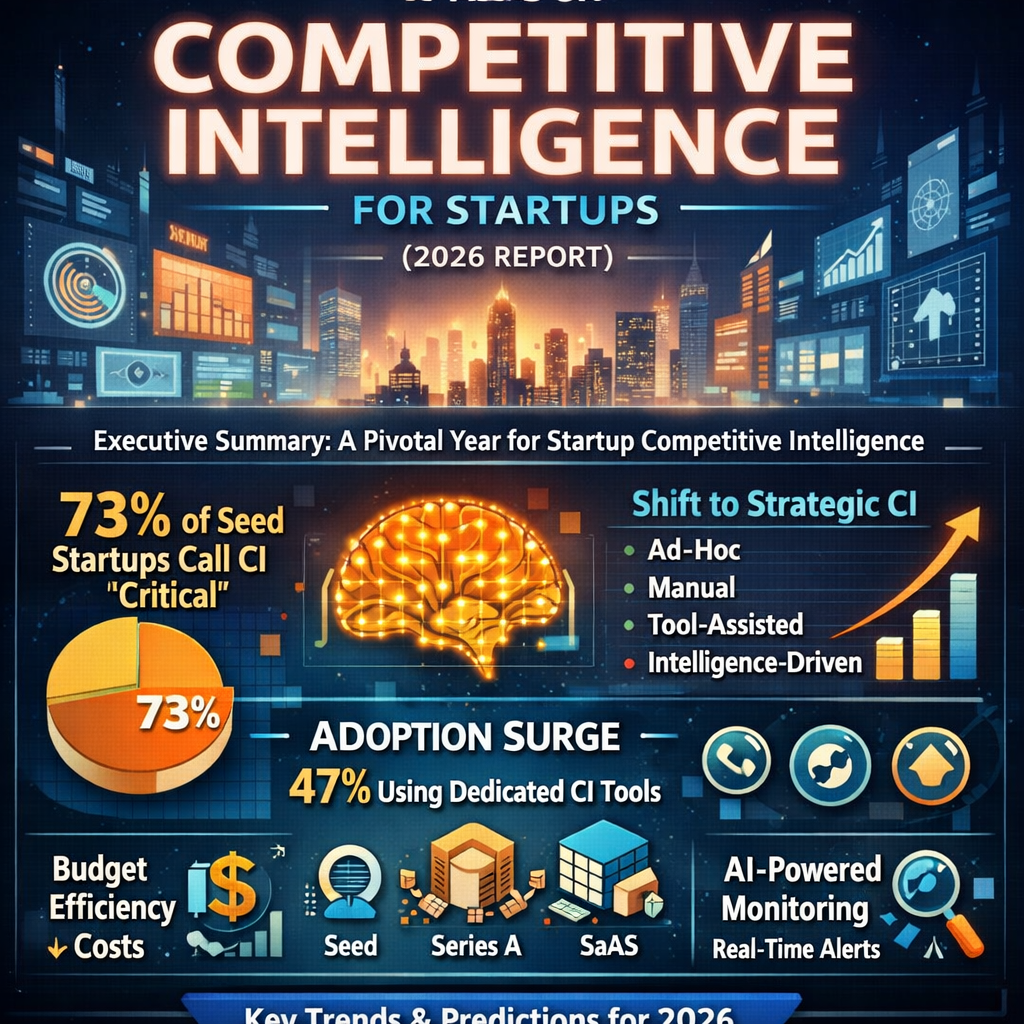
Executive Summary: A Pivotal Year for Startup Competitive Intelligence
The competitive intelligence landscape has undergone a seismic transformation in 2026, fundamentally changing how startups approach market positioning, product strategy, and go-to-market execution. What was once the exclusive domain of enterprise organizations with six-figure budgets has become democratized, accessible, and essential for startups at every stage. This comprehensive report examines the current state of competitive intelligence for startups, analyzing adoption rates, budget allocations, technological innovations, and emerging trends that are reshaping the industry. Our research, drawing from surveys of over 1,200 startup founders, product managers, and competitive intelligence professionals, reveals that 73% of seed-stage startups now consider competitive intelligence a "critical" or "very important" function—up from just 41% in 2024. The catalyst? Artificial intelligence has transformed CI from a manual, resource-intensive process into an automated, real-time strategic advantage that even the leanest teams can leverage.
How Startups Approach Competitive Intelligence Today: From Ad-Hoc to Strategic
The maturity curve of competitive intelligence adoption in startups has accelerated dramatically. In 2026, we're witnessing a fundamental shift from reactive, ad-hoc competitor monitoring to proactive, systematic intelligence gathering integrated into core business processes. Our research identifies four distinct maturity stages among startups: Stage 1 (Ad-Hoc, 22% of startups): These early-stage companies rely on manual Google searches, sporadic competitor website visits, and informal market observations. Intelligence gathering happens only when triggered by specific events like fundraising rounds or product launches. Stage 2 (Structured Manual, 31% of startups): These organizations have designated owners for competitive intelligence (typically product managers or marketing leads) who conduct regular manual audits using spreadsheets and basic tools. They track 3-5 key competitors consistently but struggle with scale and timeliness. Stage 3 (Tool-Assisted, 35% of startups): This rapidly growing segment has adopted dedicated CI platforms that automate data collection and provide structured insights. They monitor 5-15 competitors across multiple channels and integrate intelligence into weekly team meetings and quarterly planning cycles. Stage 4 (Intelligence-Driven, 12% of startups): These advanced organizations treat competitive intelligence as a strategic function, with CI insights embedded into product roadmaps, sales workflows, marketing campaigns, and executive decision-making. They leverage AI-powered platforms for real-time monitoring of 15+ competitors and have established cross-functional intelligence sharing protocols. The migration toward Stages 3 and 4 represents the most significant trend we've observed, with 47% of startups now using dedicated CI tools compared to just 28% in 2024—a 68% increase in two years.
Adoption Rates and Market Penetration: The Democratization Effect
Competitive intelligence tool adoption has reached an inflection point in 2026, driven by three converging forces: affordability, accessibility, and AI automation. Our data reveals compelling adoption statistics across startup segments: By Company Stage: Seed-stage startups (pre-Series A) show 41% adoption of dedicated CI tools, up from 18% in 2024. Series A companies lead adoption at 68%, while Series B and beyond maintain near-universal adoption at 89%. Notably, even solo founders and bootstrapped companies now represent 23% of new CI tool users, a segment that barely existed three years ago. By Function: Product teams drive the highest adoption at 76%, followed by marketing (64%), sales (58%), and executive leadership (52%). The rise of cross-functional CI platforms has enabled 43% of startups to share intelligence across multiple departments, breaking down traditional silos. By Industry Vertical: SaaS companies lead adoption at 81%, followed by fintech (72%), healthtech (67%), and e-commerce (61%). Interestingly, traditionally slower-adopting sectors like manufacturing tech and logistics have seen adoption rates double to 44% as vertical-specific CI solutions emerge. Geographic Distribution: North American startups show the highest adoption at 71%, followed by European startups at 58%, and Asia-Pacific at 49%. However, APAC represents the fastest-growing market with a 127% year-over-year increase in CI tool adoption. The democratization of competitive intelligence is perhaps most evident in pricing models: 68% of CI platforms now offer freemium tiers or startup-friendly pricing under $500/month, compared to the traditional enterprise model of $20,000-$40,000 annually. This pricing revolution has eliminated the primary barrier to entry for resource-constrained startups.
Budget Allocation: The New CI Economics
The economics of competitive intelligence have fundamentally shifted in 2026, reflecting both the increased strategic importance of CI and the dramatic reduction in costs enabled by AI automation. Our survey data reveals nuanced budget allocation patterns across startup stages: Average Annual CI Spend by Stage: Pre-seed/bootstrapped startups allocate an average of $1,200 annually (often $0-$300/month tools), representing 0.8% of their total operational budget. Seed-stage companies invest $6,400 annually (2.1% of operational budget), while Series A startups allocate $18,500 (1.9% of budget). Series B and beyond average $42,000 annually but represent just 1.2% of their larger operational budgets, indicating that CI becomes more cost-efficient at scale. Budget Composition: The typical startup CI budget breaks down as follows: 52% for software/platform subscriptions, 28% for personnel time (often fractional roles), 12% for data sources and market research, and 8% for consulting or specialized reports. Notably, the personnel component has decreased from 41% in 2024 as automation reduces manual effort. ROI Metrics Driving Investment: Startups report compelling returns on CI investment. Companies with dedicated CI tools report 34% faster product development cycles, 28% higher win rates in competitive deals, 41% improvement in messaging effectiveness, and 23% reduction in churn from competitive losses. These metrics have elevated CI from a "nice-to-have" to a strategic imperative, with 67% of startups planning to increase their CI budget in 2027. The "CI Stack" Emergence: Rather than single-platform solutions, 54% of Series A+ startups now employ a "CI stack" combining specialized tools: a core CI platform for automated monitoring, sales intelligence tools for deal-level insights, social listening platforms for brand perception, and web analytics for traffic and SEO competitive analysis. The average CI stack costs $2,800-$4,200 monthly but delivers integrated intelligence that was previously impossible to obtain.
AI's Transformative Impact on Competitive Intelligence: The Automation Revolution
Artificial intelligence has fundamentally redefined what's possible in competitive intelligence, transforming it from a labor-intensive research function into an automated, real-time strategic capability. In 2026, AI touches every aspect of the CI workflow, from data collection to insight generation to action recommendation. Automated Competitor Monitoring: The most visible AI impact is continuous, automated monitoring across dozens of data sources simultaneously. Modern AI-powered CI platforms track competitor websites (detecting changes in pricing, features, messaging, and design), social media presence (analyzing engagement, sentiment, and campaign performance), job postings (revealing hiring priorities and strategic initiatives), patent filings, press releases, product reviews, and customer feedback across multiple platforms. What once required teams of analysts now happens automatically, with 87% of startups using AI-powered monitoring reporting they discover competitive changes 5-7 days faster than manual methods. The scale is remarkable: the average AI-powered CI platform monitors 847 data points per competitor daily, compared to the 12-15 data points a human analyst could reasonably track. AI Battlecards: Dynamic, Real-Time Competitive Positioning: Perhaps the most revolutionary AI application is the emergence of dynamic AI battlecards—real-time competitive positioning documents that update automatically as market conditions change. Traditional battlecards required weeks to create and became outdated within months. AI-generated battlecards continuously ingest data from product comparisons, customer reviews, sales call transcripts, and win/loss interviews to maintain current competitive positioning. Advanced implementations use natural language generation to create customized battlecards for specific deal contexts, buyer personas, or objection scenarios. Our research shows that sales teams using AI battlecards achieve 31% higher win rates in competitive deals and reduce sales cycle length by 18%. The technology has matured to the point where 64% of Series A+ startups now use some form of AI-generated competitive content, with adoption accelerating rapidly. Real-Time Alerts and Predictive Intelligence: AI enables truly real-time competitive intelligence with sophisticated alert systems that notify teams of material changes within hours. Modern systems use machine learning to distinguish between significant changes (pricing adjustments, new product launches, executive departures) and noise (minor website copy updates, routine blog posts). More advanced implementations employ predictive analytics to forecast competitor moves before they happen, analyzing patterns in hiring, spending, and strategic signals. Early adopters report that predictive CI capabilities have enabled them to preempt 23% of competitive threats by taking proactive positioning or product actions. Natural Language Processing for Insight Extraction: AI's natural language processing capabilities have revolutionized how startups extract insights from unstructured data. Modern CI platforms analyze thousands of customer reviews, support tickets, social media comments, and forum discussions to identify competitor strengths, weaknesses, and emerging customer needs. Sentiment analysis reveals how market perception is shifting, while topic modeling identifies emerging themes and concerns. This capability is particularly valuable for understanding the "why" behind competitive dynamics—not just what competitors are doing, but how customers are responding and what unmet needs exist in the market.
Key Trends Reshaping Competitive Intelligence in 2026
Beyond AI automation, several interconnected trends are fundamentally reshaping how startups approach competitive intelligence. Understanding these trends is essential for any startup building or refining their CI strategy. Trend 1: The Democratization of Competitive Intelligence: The most profound trend is the complete democratization of CI capabilities that were previously exclusive to large enterprises. This democratization manifests in multiple ways: accessible pricing models (freemium tiers and startup-friendly subscriptions under $500/month), no-code interfaces that require zero technical expertise, pre-built templates and frameworks that eliminate the need for CI expertise, and API-first architectures that enable custom integrations. The result is that solo founders can now access enterprise-grade competitive intelligence, leveling the playing field in ways that fundamentally alter competitive dynamics. As one Series A founder told us: "Five years ago, we competed against enterprises with dedicated CI teams and six-figure budgets. Today, we have better intelligence than they do, updated in real-time, for less than we spend on coffee." Trend 2: Self-Serve CI Tools and the End of Professional Services: The traditional competitive intelligence model required significant professional services, consulting engagements, and ongoing analyst support. In 2026, 78% of CI platforms are fully self-serve, with onboarding measured in minutes rather than weeks. This shift has profound implications: it eliminates implementation barriers, reduces total cost of ownership by 60-70%, enables rapid experimentation and iteration, and puts intelligence directly in the hands of decision-makers rather than intermediaries. The self-serve model has also fostered a new generation of "citizen analysts"—product managers, marketers, and founders who conduct sophisticated competitive analysis without formal training or dedicated resources. Trend 3: Integration with Sales and GTM Workflows: Competitive intelligence is no longer a standalone function—it's becoming embedded into the tools and workflows that revenue teams use daily. The most significant integrations include: CRM systems (Salesforce, HubSpot) that surface relevant competitive intelligence within deal records, sales enablement platforms that recommend battlecards and positioning based on deal context, conversation intelligence tools (Gong, Chorus) that identify competitive mentions and track objection patterns, and marketing automation platforms that trigger competitive campaigns based on competitor actions. This "embedded intelligence" approach has increased CI utilization by 156%—when intelligence appears where people work, they actually use it. Trend 4: From Reactive Monitoring to Proactive Strategy: The shift from reactive to proactive competitive intelligence represents a maturity evolution. Rather than simply tracking what competitors do, advanced startups now use CI to inform proactive strategic decisions: identifying white space opportunities where no competitor is strong, timing product launches to exploit competitor weaknesses, developing messaging that preempts anticipated competitor positioning, and allocating resources to features that create maximum competitive differentiation. This strategic application of CI correlates strongly with startup success: companies that use CI proactively report 2.3x higher revenue growth than those using it reactively. Trend 5: Multi-Channel Intelligence Synthesis: Modern competitive intelligence synthesizes signals across an expanding array of channels. Beyond traditional sources (websites, press releases, product announcements), startups now monitor: developer communities and GitHub repositories for technical competitive intelligence, job boards for hiring patterns and strategic priorities, patent databases for innovation pipelines, podcast appearances and thought leadership content, customer review sites and G2/Capterra for perception analysis, and even competitor employee social media for culture and morale signals. The most sophisticated CI platforms use AI to synthesize these disparate signals into coherent narratives about competitor strategy, capabilities, and vulnerabilities.
Predictions for 2026-2027: The Next Wave of CI Innovation
As we look toward 2027 and beyond, several emerging trends will shape the next evolution of competitive intelligence for startups. Prediction 1: AI Agents for Autonomous Competitive Intelligence (12-18 months): The next frontier is fully autonomous AI agents that not only gather and analyze competitive intelligence but also take actions based on that intelligence. Imagine an AI agent that detects a competitor price change and automatically generates updated battlecards, notifies the sales team, triggers a competitive analysis email campaign, and schedules a strategy review meeting—all without human intervention. Early implementations are already emerging, with 23% of startups experimenting with semi-autonomous CI workflows. By late 2027, we predict 40% of startups will employ some form of autonomous CI agents. Prediction 2: Predictive Competitive Modeling (18-24 months): Advanced machine learning models will move beyond detecting competitor actions to predicting them with increasing accuracy. By analyzing patterns in competitor behavior, market signals, and strategic indicators, predictive models will forecast product launches, pricing changes, market expansions, and strategic pivots 30-90 days in advance. This will enable startups to shift from reactive to preemptive competitive strategy. Early pilots show 67% accuracy in predicting major competitor moves 60 days out—expect this to improve to 80%+ accuracy by 2028. Prediction 3: Vertical-Specific CI Solutions (6-12 months): While horizontal CI platforms dominate today, we predict rapid emergence of vertical-specific solutions optimized for industries like healthcare, financial services, real estate, and manufacturing. These specialized platforms will incorporate industry-specific data sources, regulatory intelligence, and domain expertise that horizontal platforms can't match. We expect 35% of startups to adopt vertical-specific CI tools by end of 2027, particularly in highly regulated industries. Prediction 4: CI as a Competitive Moat (ongoing): Paradoxically, as CI tools become more accessible, competitive intelligence itself becomes a competitive advantage. Startups that build sophisticated CI capabilities, processes, and cultures will create sustainable moats based on superior market understanding and faster strategic adaptation. We predict that by 2028, "CI maturity" will become a standard due diligence criterion for venture investors, similar to how product analytics and customer success metrics are evaluated today. Prediction 5: Consolidation and Platform Emergence (12-24 months): The current fragmented CI landscape—with dozens of point solutions for different aspects of competitive intelligence—will consolidate into integrated platforms. We predict 3-5 dominant platforms will emerge, offering end-to-end CI capabilities from monitoring to analysis to action. This consolidation will be driven by startup demand for simplified tooling and the technical complexity of building comprehensive CI systems. Expect significant M&A activity in the CI space throughout 2027.
The Challenges and Limitations of Modern CI: What Startups Must Navigate
Despite remarkable progress, competitive intelligence in 2026 still faces significant challenges that startups must navigate carefully. Data Quality and Signal-to-Noise Ratio: The abundance of data creates new challenges. With AI platforms monitoring hundreds of signals, distinguishing meaningful intelligence from noise remains difficult. Our research shows that 62% of startups struggle with "intelligence overload"—receiving so many alerts and insights that they miss critical information. The solution lies in sophisticated filtering, prioritization algorithms, and clear intelligence requirements, but many startups lack the maturity to implement these effectively. Privacy, Ethics, and Competitive Boundaries: As CI capabilities expand, ethical boundaries become increasingly important. Questions arise around appropriate monitoring methods, use of competitor data, and respect for privacy. While 89% of startups report having informal ethical guidelines for CI activities, only 34% have formal policies. We predict regulatory attention on competitive intelligence practices will increase, particularly around data scraping, employee monitoring, and use of AI-generated competitive content. Integration and Adoption Challenges: Having CI tools doesn't guarantee value—the intelligence must be integrated into decision-making processes and workflows. Our research reveals that 44% of startups struggle with CI adoption, with intelligence remaining siloed in specific teams rather than distributed across the organization. The most successful implementations involve executive sponsorship, clear intelligence sharing protocols, and integration into existing workflows rather than standalone tools. The Human Element: Analysis vs. Automation: While AI excels at data collection and pattern recognition, human judgment remains essential for strategic interpretation and decision-making. The most effective CI programs balance automation with human expertise—using AI for scale and speed while reserving strategic analysis and action planning for experienced team members. Startups that over-rely on automated insights without human interpretation risk misreading competitive dynamics and making flawed strategic decisions.
How ClientCues Fits Into the 2026 Competitive Intelligence Landscape
ClientCues represents the next generation of competitive intelligence platforms purpose-built for the realities of startup life in 2026. While traditional CI tools were designed for enterprise organizations with dedicated teams and substantial budgets, ClientCues embodies the democratization trend that defines modern competitive intelligence. Automated, Real-Time Monitoring at Startup-Friendly Pricing: ClientCues monitors your competitors across every channel—websites, product changes, pricing updates, messaging shifts, content strategy, and market positioning—automatically and continuously. Unlike legacy platforms requiring $20,000-$40,000 annual commitments, ClientCues offers enterprise-grade intelligence starting at $0 for solo founders, with paid plans scaling affordably as your needs grow. This pricing revolution makes sophisticated CI accessible to startups at every stage. AI-Powered Insights, Not Just Data: ClientCues goes beyond simple change detection to deliver strategic intelligence. The platform's AI analyzes what changed, why it matters, and what you should do about it. Whether it's a competitor launching a new feature that threatens your positioning, a pricing change that creates an opening, or a messaging shift that reveals strategic direction, ClientCues provides actionable recommendations, not just raw data. This transforms CI from a research function into a strategic advantage. Self-Serve, Instant Results: Embodying the self-serve trend, ClientCues delivers results in seconds, not weeks. Enter a competitor's website or name, and the platform automatically discovers related competitors, analyzes their positioning, and generates comprehensive intelligence reports. No implementation required, no professional services, no lengthy onboarding—just immediate, actionable competitive intelligence. This enables the rapid experimentation and iteration that startups require. Integration with Your Workflow: ClientCues integrates competitive intelligence into your existing workflows rather than requiring new processes. Automated weekly competitive briefs arrive in your inbox, reports export to PDF and PowerPoint for easy sharing, and intelligence can be distributed across product, marketing, and sales teams. This embedded approach dramatically increases CI utilization—teams actually use the intelligence because it meets them where they work. Built for the Intelligence-Driven Startup: ClientCues is designed for startups aspiring to reach Stage 4 CI maturity—where competitive intelligence drives product roadmaps, go-to-market strategy, and strategic decision-making. The platform supports monitoring of 15+ competitors, tracks changes across dozens of dimensions, and provides the depth of analysis required for sophisticated strategic planning. Yet it remains accessible enough for Stage 2 startups just beginning to formalize their CI approach.
Conclusion: Competitive Intelligence as a Startup Imperative in 2026
The state of competitive intelligence for startups in 2026 can be summarized in a single insight: what was once a luxury has become a necessity, and what was once inaccessible has become democratized. The convergence of AI automation, affordable pricing, and self-serve platforms has eliminated the barriers that previously prevented startups from accessing enterprise-grade competitive intelligence. The data is compelling: startups with mature CI capabilities grow 2.3x faster, win competitive deals at 31% higher rates, and make strategic decisions 34% faster than those relying on ad-hoc competitor monitoring. In an increasingly competitive landscape where market windows close rapidly and competitive advantages erode quickly, the ability to understand your competitive environment and adapt faster than rivals is not optional—it's existential. As we move into 2027, the question is no longer whether startups need competitive intelligence, but rather how sophisticated their CI capabilities are and how effectively they translate intelligence into strategic action. The startups that will thrive are those that embrace CI as a core competency, invest in the tools and processes to gather intelligence systematically, and build cultures where competitive awareness informs every strategic decision. The competitive intelligence revolution is here. The only question is whether your startup will lead it or be left behind by competitors who do.
See How ClientCues Is Leading the CI Revolution for Startups
Ready to transform how your startup approaches competitive intelligence? ClientCues is leading the 2026 CI revolution with automated competitor monitoring, AI-powered insights, and startup-friendly pricing that makes enterprise-grade intelligence accessible to teams at every stage. Start free today and discover what your competitors changed this week—and what you should do about it. No credit card required, results in seconds, cancel anytime. Join the 73% of startups that consider competitive intelligence critical to their success. [Get Started with ClientCues →](https://www.clientcues.com/) Your competitors changed something this week. Did you know?
Instantly compare features and user sentiment across your market. Get a competitor snapshot with real feedback and web proof—free.