AI Workflow Integration
How We Built Deep Competitor Analysis with Evaligo Multi-Node Agentic Flows
- Jump to section:
- The Architecture: 8 Specialized Agents in One Flow
- Real Results: Deep Scan of Crayon.co
- Structured Features and Integrations
- Signals: Social Proof, Hiring, and Content
- Two-Tier Scan Strategy
- Why Evaligo
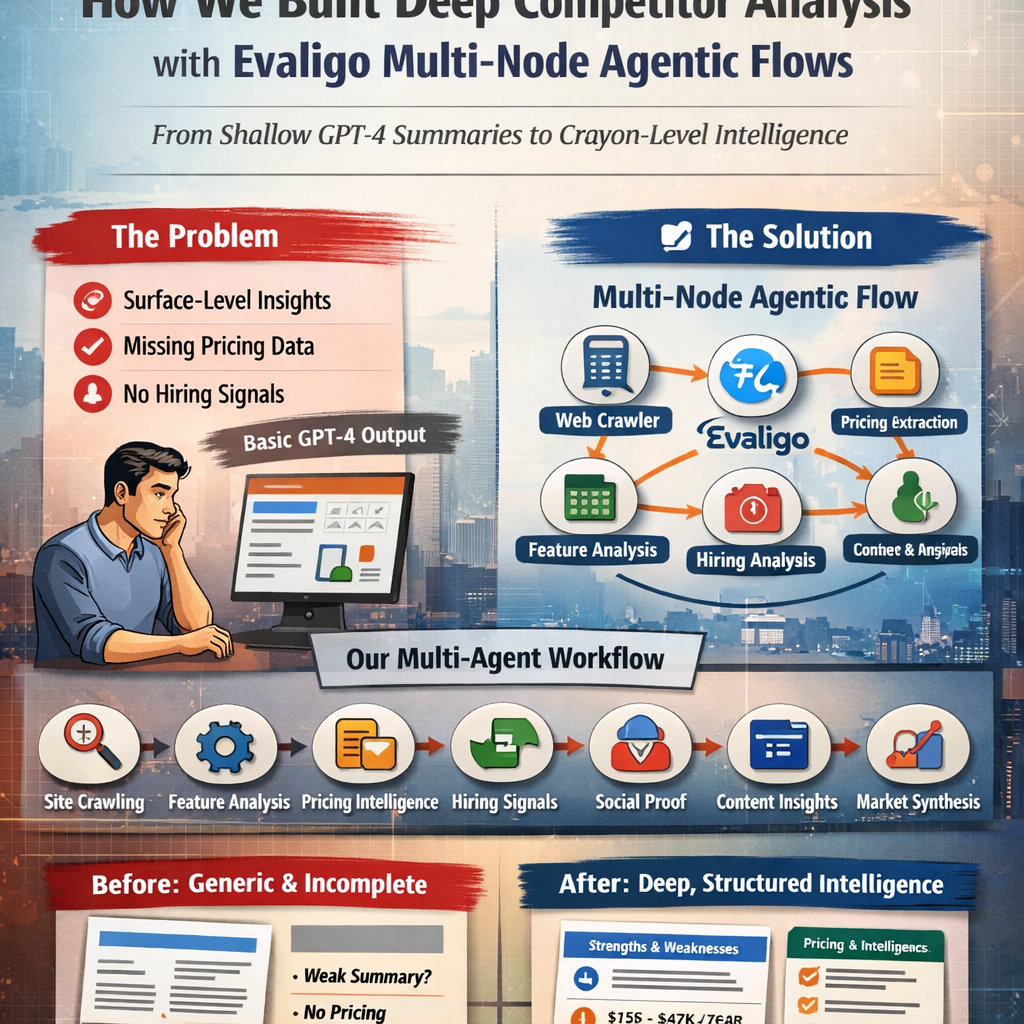
How We Built Deep Competitor Analysis with Evaligo Multi-Node Agentic Flows
At ClientCues we set out to build a competitive intelligence platform that could deliver structured, actionable insights about any competitor from just a URL. The approach: orchestrate multiple specialized AI agents inside a single Evaligo workflow — each agent crawls specific pages, extracts structured data, and feeds its output to the next. The result is a rich competitor profile covering features, pricing, positioning, social proof, hiring signals, and content strategy — all produced automatically in about five minutes.
The Architecture: 8 Specialized Agents in One Flow
Instead of asking one model to do everything, we built a multi-node Evaligo flow where each node is a specialized agent powered by Sonnet 4.6. Each agent crawls the specific pages it needs, extracts structured data, and passes the result forward. No web search — everything comes from crawling the competitor's actual site.
1. Web Crawling Agent — Intelligently navigates the site structure to locate the homepage, pricing page, features page, careers page, blog, customers page, and integrations page. Uses URL patterns and link text analysis to find pages even when they're buried outside the main navigation.
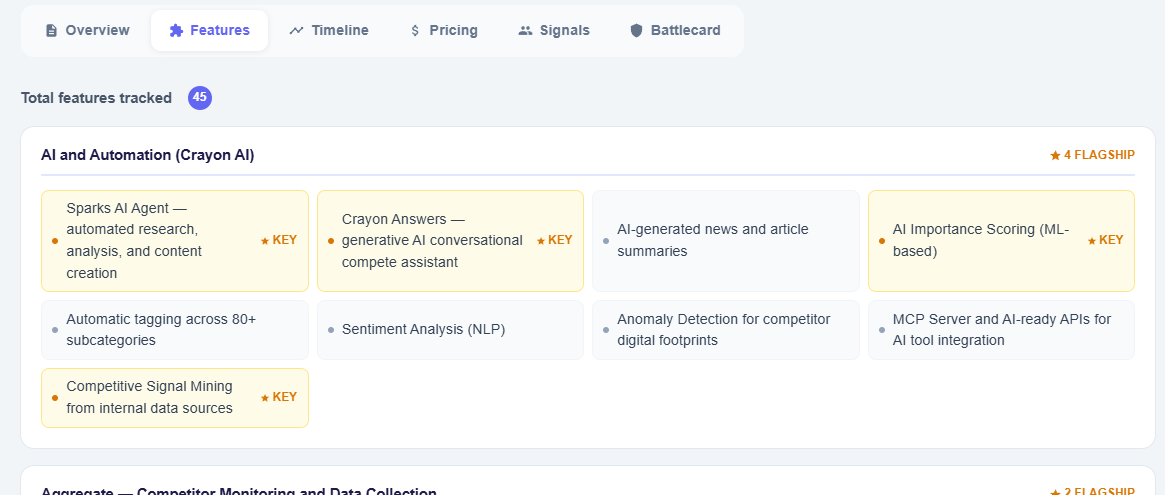
2. Feature Extraction Agent — Builds a structured feature taxonomy: categories, individual features with flagship badges, and a complete integrations list. For Crayon, it found 45 features across 5 categories and 31 integrations including Salesforce, Slack, Gong, and ChatGPT.
3. Positioning Analysis Agent — Extracts the competitor's exact headline, tagline, value proposition, target ICP (company size, buyer persona, primary use case), messaging pillars, tone of voice, and differentiators with evidence URLs pointing back to source pages.
4. Pricing Intelligence Agent — Discovers pricing tiers, value metrics, enterprise availability, and annual discounts by crawling pricing pages and related content across the site. For Crayon, it estimated $15K–$47K/year across three tiers even though their pricing page only shows "Contact Sales."
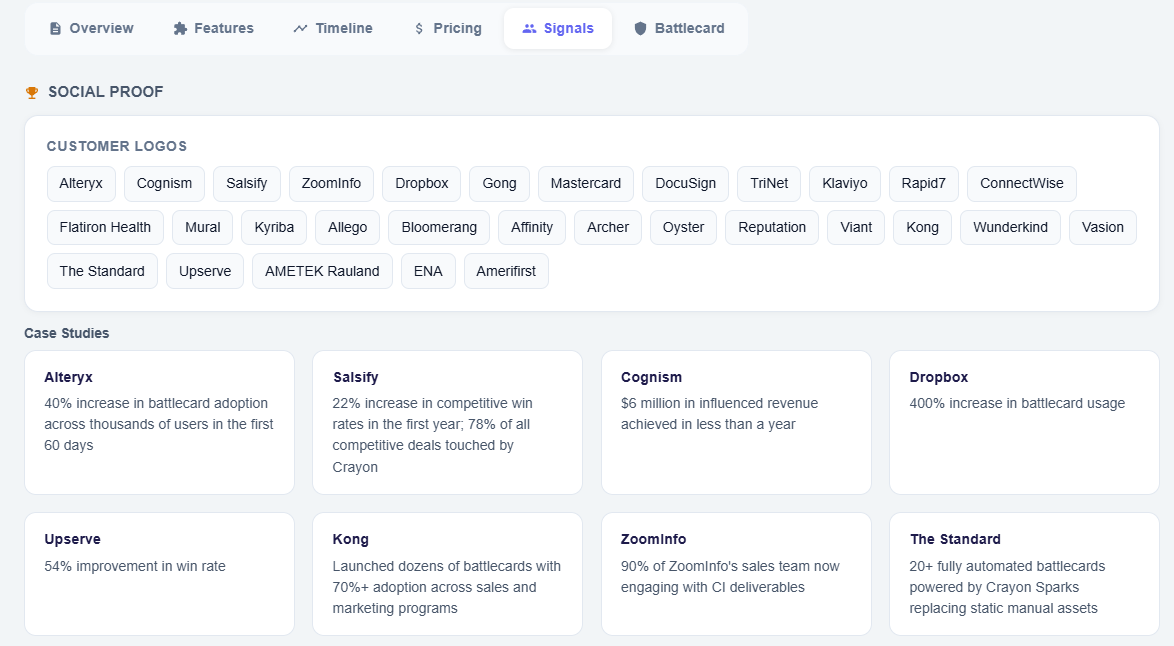
5. Social Proof Agent — Extracts customer logos, case studies with quantified results, awards, and recognition from the customers page and case study pages.
6. Hiring Signals Agent — Crawls the careers page for open roles count, growth signals, notable positions, and key departments expanding.
7. Content Strategy Agent — Analyzes the blog for publishing frequency, content themes, and recent posts with dates.
8. Market Analysis Agent — Synthesizes everything into strengths, weaknesses, market position (leader/challenger/niche), threat level, and a market gap analysis identifying where the competitor is vulnerable.
Real Results: Deep Scan of Crayon.co
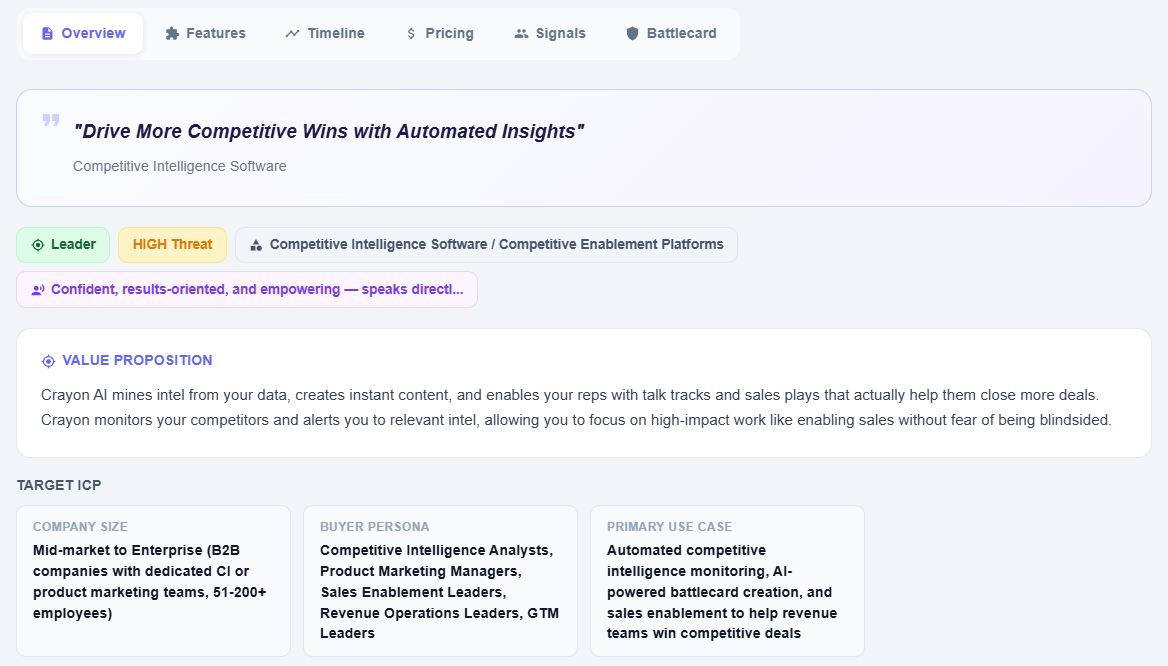
Here's what a single deep scan produced for Crayon, one of the most established players in competitive intelligence. The Overview tab shows their exact headline, at-a-glance badges (Leader, HIGH Threat, category), full value proposition, and target ICP broken into Company Size, Buyer Persona, and Primary Use Case.
Structured Features and Integrations
The Features tab shows 45 features organized by category with KEY and FLAGSHIP badges highlighting Crayon's most differentiated capabilities — Sparks AI Agent, Crayon Answers, AI Importance Scoring. Below that, a complete integrations grid: Salesforce, Slack, Gong, Teams, ChatGPT, and dozens more.
Signals: Social Proof, Hiring, and Content
The Signals tab surfaces intelligence most tools miss entirely. 25+ customer logos extracted from Crayon's site, plus 8 case studies with quantified results — Alteryx saw 40% increase in battlecard adoption, Salsify reported 22% increase in competitive win rates, Cognism achieved $6M in influenced revenue. Below that: hiring signals showing growth trends and open roles, and content signals with publishing frequency and themes.
Two-Tier Scan Strategy
We run two Evaligo flows to balance depth and speed:
Deep Scan (~5 minutes, Sonnet 4.6) — The full 8-agent flow. Used for tracked competitors of paying customers (weekly refresh) and popular companies (nightly refresh). Each agent crawls the relevant pages and produces structured output that feeds into the next.
Fast Scan (~40 seconds, GPT 5.4 mini) — A lighter flow for the demo experience. Visitors get a quick positioning summary, high-level features, estimated pricing, and top strengths and weaknesses — with an upsell to unlock the full deep scan.
Why Evaligo
The key advantage is platform maturity. We composed the agents into a reliable workflow where we can edit and iterate on each agent's prompt independently, debug with detailed logs for every step, deploy flows for repeated API execution, and monitor costs and success rates — all at almost zero added cost beyond the underlying model costs.
The entire backend integration was one API call to trigger the flow, one to poll for results, and a mapping function to store the structured output. On the frontend, a tabbed React UI conditionally shows each section based on available data.
Instantly compare features and user sentiment across your market. Get a competitor snapshot with real feedback and web proof—free.