Sales Enablement
How to Create Sales Battlecards That Your Team Will Actually Use
- Jump to section:
- What Makes a Great Sales Battlecard (And What Doesn't)
- The Anatomy of a Battlecard That Wins Deals
- How to Gather Competitive Intelligence for Battlecards
- Keeping Battlecards Fresh: The Maintenance Challenge
- How AI Is Revolutionizing Battlecard Creation and Maintenance
- Implementing Your Battlecard Program: Practical Steps
- Real-World Battlecard Success: What It Looks Like
- Your Next Steps: From Reading to Results
What Makes a Great Sales Battlecard (And What Doesn't)
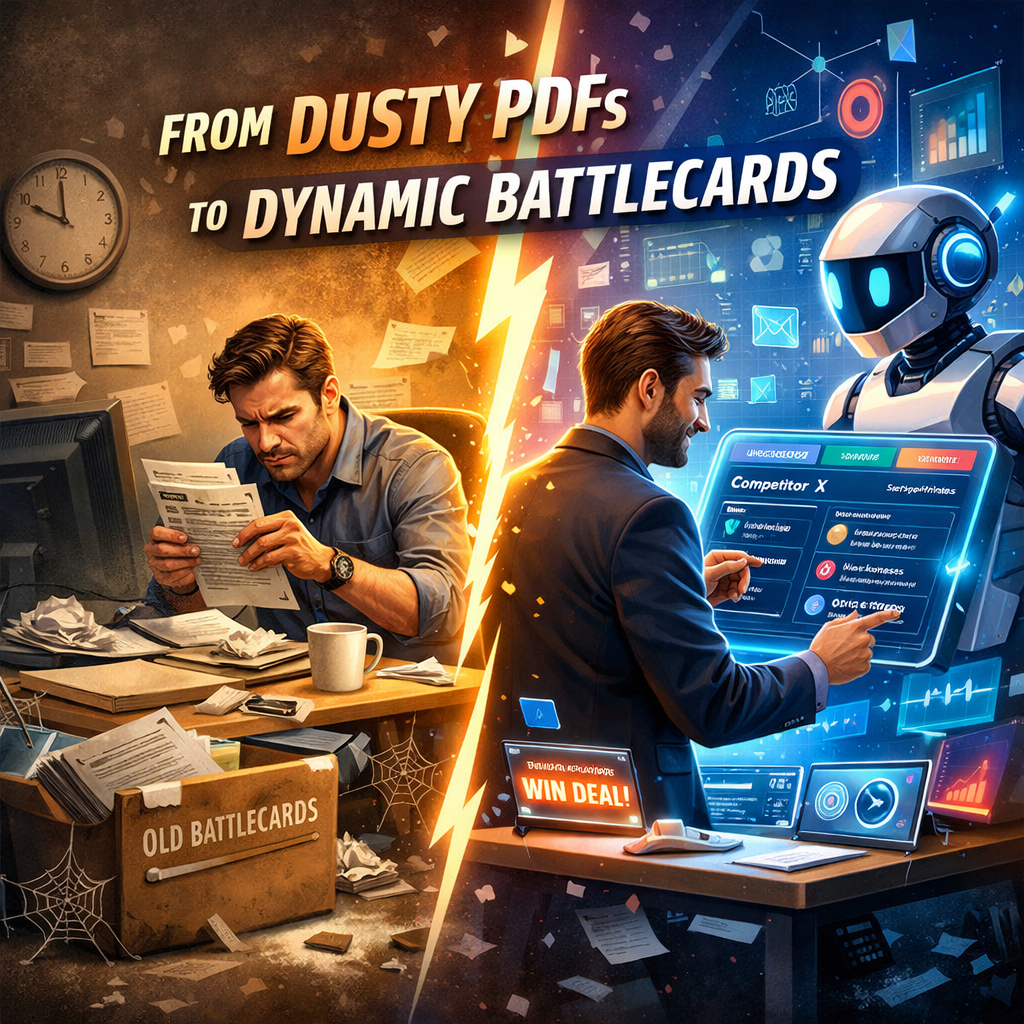
If you've ever watched a sales rep frantically searching through outdated PDFs during a competitive deal, you know the problem. Sales battlecards are supposed to be the ultimate competitive weapon—quick-reference guides that arm your team with everything they need to win against specific competitors. But here's the reality: most battlecards gather digital dust in forgotten folders, never to be opened again after their initial creation.
What Makes a Great Sales Battlecard (And What Doesn't)
The best sales battlecards share three critical characteristics: they're scannable, actionable, and current. Scannable means a rep can find what they need in under 10 seconds during a live call. Actionable means every piece of information translates directly into something they can say or do. Current means the intel is fresh enough to be trusted—nothing kills credibility faster than citing a competitor feature that changed six months ago.
What doesn't work? The kitchen-sink approach. Too many organizations create 10-page battlecard documents that try to cover every possible scenario. Your sales team doesn't have time to read a novel when a prospect asks, "How are you different from [Competitor X]?" They need the answer now, in their own words, backed by proof points they can remember. Similarly, generic battlecards that treat all competitors the same miss the nuance that wins deals. Your approach to competing against an established enterprise player should look completely different from how you position against a scrappy startup.
The most common mistake? Creating battlecards once and forgetting about them. In today's market, competitors ship new features weekly, adjust pricing monthly, and pivot positioning quarterly. A battlecard created in January 2026 that hasn't been updated by March is already outdated. This is where most sales enablement efforts fail—not in creation, but in maintenance.
The Anatomy of a Battlecard That Wins Deals
An effective sales battlecard follows a specific structure designed for quick reference and maximum impact. Here's the ideal battlecard template outline that actually gets used:
Quick Facts Section (Top 30% of the card)
This section should be digestible in a 5-second glance. Think of it as your "competitive snapshot" that orients the rep before they dive deeper.
Strengths & Weaknesses (Core Intelligence)
Honesty matters here. If you pretend a competitor has no strengths, your sales team won't trust the battlecard. Acknowledging what competitors do well while highlighting where you excel builds credibility with both your team and prospects.
Objection Handlers (The Money Section) This is where battlecards prove their worth. List the 5-7 most common objections you hear when competing against this specific competitor, along with proven responses. Format these as:
Notice the structure: acknowledge, reframe, provide proof, ask a question. This format works because it doesn't sound defensive.
Kill Shots (Your Secret Weapons) These are your 2-3 most powerful competitive differentiators—the things that consistently win deals. These might be:
Keep these concise and backed by proof. "We're 10x faster" needs to be "We process 10,000 records in 2 seconds vs. their 45 seconds, as verified by [source]."
Discovery Questions (Often Overlooked, Always Valuable) Include 5-7 questions that help reps identify if a prospect is a good fit for your solution vs. the competitor. Examples:
These questions do double duty: they uncover pain points and subtly highlight your advantages.
Proof Points & Resources
End with links to deeper resources, but keep them minimal. The battlecard itself should be self-contained.
- Competitor name and positioning tagline
- Founded date and company size
- Pricing model (high-level)
- Target customer profile
- Key differentiators (3-4 bullets max)
- Their strengths: 3-5 things they genuinely do well (yes, be honest)
- Their weaknesses: 3-5 areas where they fall short
- Why prospects choose them: Real reasons from win/loss analysis
- Why prospects choose us instead: Your actual competitive advantages
- Objection: "They're the market leader with more customers"
- Response: "You're right, they've been around longer. What we're seeing though is that their legacy architecture means [specific limitation]. Companies like [customer example] chose us specifically because [concrete benefit]. What matters more to you—brand recognition or [relevant outcome]?"
- A unique capability they can't match
- A pricing/packaging advantage
- A specific integration or partnership
- A customer success metric that speaks for itself
- "How important is [feature you excel at] to your workflow?"
- "What's your timeline for implementation?" (if you're faster)
- "Who else needs to be involved in this decision?" (if you have better stakeholder management)
- Customer testimonials mentioning this competitor
- Case studies of customers who switched
- Third-party reviews or analyst reports
- Demo scenarios that highlight key differences
How to Gather Competitive Intelligence for Battlecards
The quality of your battlecards depends entirely on the quality of your competitive intelligence. In 2026, you have more sources than ever, but you also have more noise. Here's how to gather intel that actually matters:
Win/Loss Interviews: Your Gold Mine Nothing beats talking to prospects who chose you over a competitor—or chose them over you. These conversations reveal the real decision criteria, not what you think matters. Ask specific questions: "What did [Competitor] say about us? What feature did they emphasize? What made you ultimately choose us?" For losses, ask: "What could we have done differently? What did they offer that we didn't?"
Sales Team Debriefs Your reps are in the trenches daily. Create a simple feedback loop where they can report competitive intel: new pricing they've heard, new features prospects mention, new positioning angles competitors are using. A shared Slack channel or quick weekly survey can capture this ongoing intelligence.
Competitor Monitoring Track their website changes, product updates, blog posts, social media, job postings, and review sites. Look for patterns: Are they hiring aggressively in customer success? (Might indicate churn problems.) Did they just release a feature you excel at? (They're playing catch-up.) Are customers complaining about specific issues in reviews? (Potential weaknesses to explore.)
Customer Conversations Your existing customers often evaluated competitors before choosing you. They also hear competitor pitches when contracts come up for renewal. These conversations provide ongoing competitive context that's incredibly current.
Industry Events and Demos Attend the same conferences your competitors do. Sign up for their demos. Read their pitch decks. Understanding their messaging helps you counter it effectively. Just be ethical—don't misrepresent who you are.
The key is creating a system for continuous intelligence gathering, not one-time research. Competitive landscapes shift constantly, and your battlecards should reflect real-time market conditions.
Keeping Battlecards Fresh: The Maintenance Challenge
Here's the hard truth: creating battlecards is the easy part. Keeping them updated is where most organizations fail. A stale battlecard is worse than no battlecard—it erodes trust and can actively hurt deals when reps cite outdated information.
Establish Update Cadences At minimum, review and update battlecards quarterly. For your top 3-5 competitors, monthly reviews are better. Assign ownership: someone needs to be responsible for each battlecard. This can't be a "whoever has time" task—it needs clear accountability.
Create Feedback Mechanisms Make it easy for sales reps to flag outdated information. Add a simple "Report an issue" link in your battlecards, or create a dedicated Slack channel. When a rep hears something new in a sales call, they should have a frictionless way to share it.
Version Control Matters Date your battlecards and track versions. When you update one, communicate what changed to your sales team. A quick Slack message: "Updated Competitor X battlecard—they changed pricing and released [new feature]. New objection handler added." This keeps the team engaged and aware.
Leverage Automation This is where modern competitive intelligence tools shine. Manual battlecard maintenance doesn't scale, especially as you track more competitors. AI-powered platforms can monitor competitor websites, track feature releases, analyze review sentiment, and flag significant changes automatically. This shifts your team from manual research to strategic analysis.
Integrate with Sales Workflows Battlecards shouldn't live in isolation. Integrate them into your CRM so reps can access them directly from opportunity records. When a rep marks a competitor in a deal, the relevant battlecard should be one click away. The easier you make access, the more they'll be used—and the more feedback you'll get on keeping them current.
How AI Is Revolutionizing Battlecard Creation and Maintenance
The traditional approach to battlecards—manual research, quarterly updates, static PDFs—doesn't match the pace of modern markets. This is where AI-powered competitive intelligence platforms are changing the game in 2026.
Automated Competitive Monitoring AI tools can continuously monitor competitor websites, product pages, pricing pages, job listings, social media, review sites, and more. When a competitor makes a significant change—launches a new feature, adjusts pricing, shifts messaging—the system detects it automatically. This means your battlecards can be updated in near real-time, not whenever someone remembers to check.
Intelligent Synthesis Beyond just monitoring, AI can synthesize information from multiple sources into coherent competitive insights. It can analyze patterns in customer reviews to identify emerging competitor weaknesses, track feature release velocity to gauge their product momentum, and even predict likely competitive moves based on hiring patterns and market signals.
Auto-Generated Battlecard Templates Platforms like ClientCues use AI to automatically generate battlecard frameworks based on competitive data. Instead of starting from scratch, you get a structured battlecard populated with current information: competitor positioning, key features, pricing intelligence, customer sentiment, and identified strengths and weaknesses. Your team then refines and adds strategic context—but the heavy lifting of research and organization is automated.
Dynamic Updates The most powerful aspect of AI-driven battlecards is that they stay current automatically. When ClientCues detects that a competitor has changed their pricing model or launched a new feature, it updates the relevant battlecard and notifies your team. This eliminates the maintenance burden that causes most battlecard programs to fail.
Conversational Intelligence Advanced AI can even analyze sales call recordings to identify which competitive talking points work best, which objections come up most frequently, and which kill shots close deals. This feedback loop continuously improves your battlecards based on real-world performance, not guesswork.
The result? Battlecards that are always accurate, always accessible, and always improving—without requiring a full-time competitive intelligence team.
Implementing Your Battlecard Program: Practical Steps
Knowing what makes a great battlecard is one thing; actually implementing a program that works is another. Here's your step-by-step approach:
Step 1: Start Small Don't try to create battlecards for every competitor on day one. Start with your top 3 competitors—the ones you encounter in 80% of competitive deals. Get these right, prove the value, then expand.
Step 2: Involve Your Sales Team Early The biggest mistake is creating battlecards in a vacuum. Interview your top reps: What information do they wish they had? What format works best for them? What objections do they struggle with? Build the battlecards with them, not for them.
Step 3: Choose Your Format While content matters most, format affects usage. Options include:
Many teams use multiple formats: a detailed web version and a condensed one-pager for quick reference.
Step 4: Launch with Training Don't just drop battlecards into a shared folder. Launch them with a training session. Walk through each battlecard, role-play objection handling, and explain how to use them in real scenarios. Record this training for new hires.
Step 5: Measure and Iterate Track usage and impact. Which battlecards get accessed most? Are win rates improving in competitive deals? Survey your sales team quarterly: Are the battlecards helpful? What's missing? What's confusing? Use this feedback to continuously improve.
Step 6: Consider AI-Powered Solutions If you're tracking more than 5 competitors, or if your market moves quickly, manual battlecard maintenance becomes unsustainable. This is where tools like ClientCues deliver ROI. Instead of dedicating hours each week to competitive research and battlecard updates, AI handles the monitoring and updating automatically. Your team focuses on strategy and selling, not manual data gathering.
The platform continuously tracks your competitors, auto-generates battlecard content, and keeps everything current without manual effort. When a competitor launches a new feature or changes pricing, you're notified immediately with updated battlecard content ready to share with your team.
- One-page PDFs (classic, easy to print)
- Interactive web pages (easy to update, searchable)
- CRM-integrated cards (accessible in workflow)
- Mobile-friendly formats (for on-the-go access)
Real-World Battlecard Success: What It Looks Like
When battlecards work, the impact is measurable. Sales cycles shorten because reps can address competitive concerns confidently and immediately. Win rates improve in competitive deals because your team has better ammunition. Onboarding time for new reps decreases because they have structured competitive knowledge at their fingertips.
One pattern we see consistently: companies with effective battlecard programs treat competitive intelligence as a continuous discipline, not a one-time project. They've built feedback loops between sales, product, and marketing. When a competitor makes a move, the information flows quickly, battlecards update, and the sales team adapts.
The companies that struggle? They create beautiful battlecards once, celebrate the launch, then watch usage drop to zero within 60 days as the information becomes stale and reps lose trust in the accuracy.
The difference comes down to systems and sustainability. Manual approaches work for a while but don't scale. AI-powered approaches—where competitive monitoring, battlecard generation, and updates happen automatically—create sustainable programs that actually deliver long-term value.
Your Next Steps: From Reading to Results
You now have the blueprint for creating sales battlecards that your team will actually use. The question is: will you build this manually, or leverage AI to do the heavy lifting?
If you're ready to implement a battlecard program that stays current automatically, try ClientCues free. Our AI-powered platform monitors your competitors continuously, auto-generates battlecards with current intelligence, and updates them automatically when competitors make changes. No more manual research. No more stale information. No more battlecards that gather dust.
Your sales team deserves competitive intelligence that's as dynamic as your market. Give them battlecards that evolve in real-time, backed by AI that never sleeps. Start your free trial today and see how automated competitive intelligence transforms your sales enablement—or let AI generate them automatically and get your first battlecard in minutes, not weeks.
The competitive battles you're fighting today won't wait for quarterly updates. Make sure your team has the intelligence they need, when they need it, every single time.
Instantly compare features and user sentiment across your market. Get a competitor snapshot with real feedback and web proof—free.