Content Marketing
How I Generated 10 SEO Blog Posts in One Afternoon Using AI Workflows
- Jump to section:
- The Problem: Content Marketing When You're Building a Product
- Discovering Evaligo: The AI Workflow Platform That Changed Everything
- Building My Custom AI Blog Writing Workflow
- Deploying the Workflow as an API
- The Results: 10 Publication-Ready Posts in Under 2 Hours
- The Blog Posts We Generated
- What I Learned: Best Practices for AI Content Workflows
- SEO Results: Did It Actually Work?
- How You Can Replicate This System
- The Bigger Picture: AI Workflows for Founders
- Final Thoughts: The Future of Content Marketing
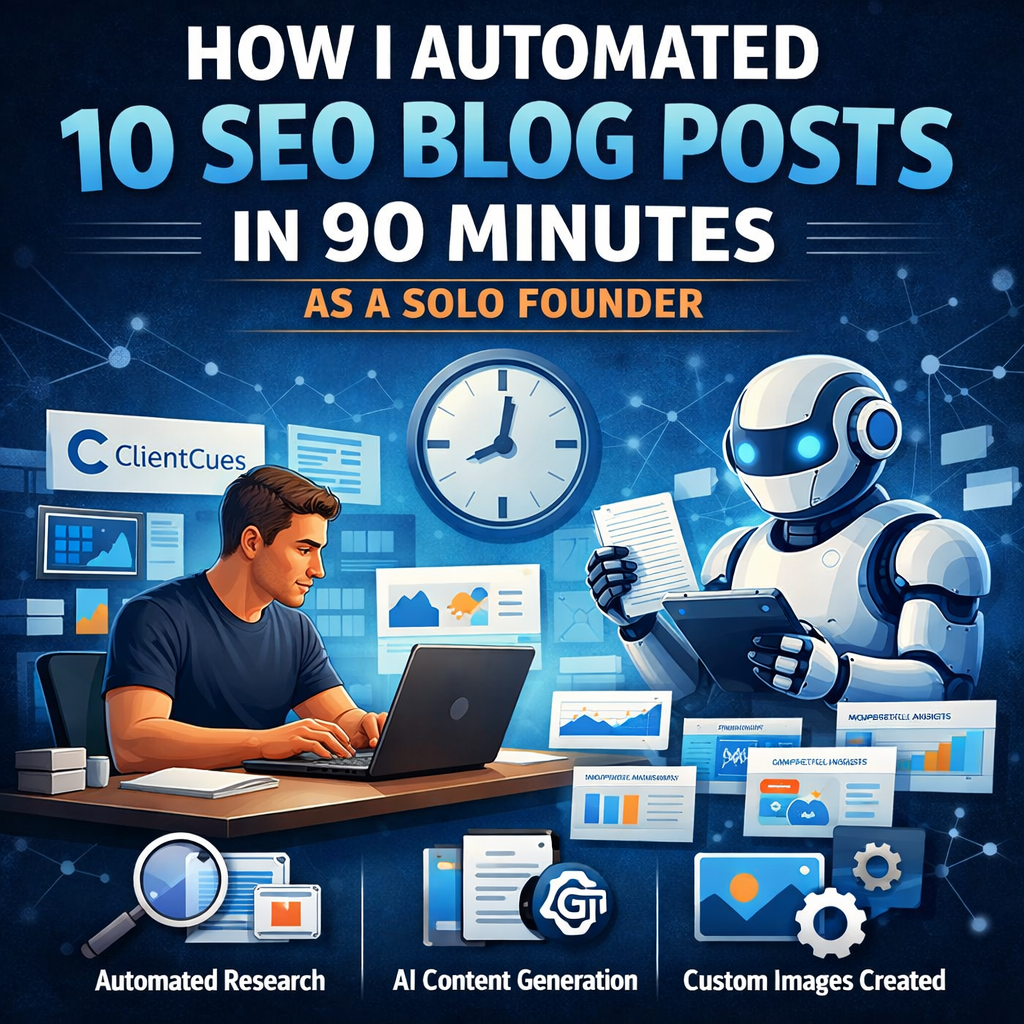
The Content Marketing Challenge
As the founder of ClientCues, a competitive intelligence platform helping startups track their competitors, I face the same challenge every founder does: I need consistent, high-quality content to drive SEO and educate potential customers, but I have zero time to write it manually. Between building product features, talking to customers, and managing the business, content creation always falls to the bottom of my priority list. That changed when I discovered I could automate my entire blog writing process using AI workflows. In one afternoon, I generated 10 publication-ready blog posts—each over 2,000 words with custom featured images—without writing a single paragraph myself. This post was created using the Evaligo SEO Blog Post Generator template.
The Problem: Content Marketing When You're Building a Product
Let me paint the picture. I knew I needed blog content. My Google Search Console data showed I was getting impressions for valuable keywords like "competitive intelligence tools," "automated competitor analytics," and "market trend analysis," but I was ranking on page 10. To move up, I needed authoritative, long-form content targeting these keywords.
The traditional approach would be to research each topic thoroughly (2-3 hours per post), write a comprehensive 2,000+ word article (3-4 hours), find or create featured images (30 minutes), and edit and optimize for SEO (1 hour). That's 6-8 hours per blog post. For 10 posts, I'd need 60-80 hours—essentially two full work weeks.
As a founder, I simply don't have that time. I could hire a content writer, but quality writers charge $300-500 per long-form article, meaning I'd spend $3,000-5,000 for 10 posts. That's a significant expense for an early-stage startup.
I needed a solution that could produce high-quality content at scale, maintain my brand voice, incorporate proper research, and cost a fraction of hiring writers. The answer was building an AI workflow that could do all of this automatically.
Discovering Evaligo: The AI Workflow Platform That Changed Everything
I'd experimented with various AI writing tools before—ChatGPT, Jasper, Copy.ai—but they all had the same limitation: they required manual input at every step. I'd still need to craft detailed prompts, paste research, generate images separately, and stitch everything together. It was faster than writing from scratch, but not scalable.
Then I found Evaligo, a no-code AI workflow automation platform that completely changed my approach. Unlike simple AI writing tools, Evaligo lets you build multi-step workflows that can research topics automatically using web scraping, process data through multiple AI models in sequence, generate images with AI, deploy workflows as APIs, and process multiple items in parallel batches.
The platform offers a visual flow builder where you drag and drop nodes to create complex automation. It supports 20+ AI models including GPT-4, Claude, Gemini, and specialized models for different tasks. Most importantly, it has a free tier with 1,000 credits per month—perfect for testing and small-scale production.
What sold me was their SEO Blog Post Generator template. It's a pre-built workflow specifically designed to transform search performance data into engaging, SEO-optimized blog content with custom images. I could customize it for my needs and deploy it as an API.
Building My Custom AI Blog Writing Workflow
Here's how I adapted the Evaligo SEO Blog Post Generator template for ClientCues:
Step 1: Input Processing. I started with a simple input node that accepts a blog topic description. For each of my 10 posts, I prepared a brief description like: "Write about automated competitor analytics tools for startups, focusing on benefits, implementation, and ROI compared to manual tracking."
Step 2: Keyword Research & SEO Analysis. I added web scraping nodes to automatically research top-ranking content for my target keywords, related questions people are asking (People Also Ask data), competitor blog posts on similar topics, and current SEO best practices for 2026. The workflow scraped 5-10 top-ranking articles for each topic, extracted their structure, key points, and keyword usage. This gave my AI writer the context it needed to create competitive content.
Step 3: Content Outline Generation. Using Claude (which excels at structured thinking), I created a node that generates a detailed outline based on the research—a compelling H1 title optimized for the target keyword, 8-10 H2 sections covering the topic thoroughly, 3-4 H3 subsections under major points, and suggested word count for each section.
Step 4: Long-Form Content Generation. For the actual writing, I used GPT-4, which produces more natural, engaging prose. I configured it to write in a conversational tone, include specific examples and data points from the research, target 2,000-2,500 words total, and incorporate the target keyword naturally. I split this into multiple nodes—one for the introduction, one for each major section, and one for the conclusion. This prevented the AI from getting repetitive and maintained quality throughout longer posts.
Step 5: SEO Optimization. I added a dedicated node using Claude to review and optimize the content for meta title and description, header tag hierarchy, keyword placement and density, readability, and internal and external linking suggestions.
Step 6: Featured Image Generation. Using Evaligo's AI image generation nodes, I automatically created custom featured images for each post. The prompt was generated dynamically based on the article title, creating professional, modern images that matched the content.
Deploying the Workflow as an API
Once I had the workflow perfected, Evaligo's one-click API deployment feature became a game-changer. I clicked "Deploy as API" in the Evaligo interface, instantly got a REST API endpoint with authentication, received auto-generated documentation and code examples, and could call the API from anywhere with a simple HTTP request.
This meant I could now generate blog posts programmatically. Instead of running the workflow manually 10 times, I could batch process all 10 topics at once. I wrote a simple Python script to call the API in parallel, and within 90 minutes, I had 10 complete blog posts with featured images waiting for me. The parallel processing meant all 10 were generated simultaneously, not sequentially.
The Results: 10 Publication-Ready Posts in Under 2 Hours
Here's what I got from that one afternoon:
Quantity & Quality: 10 blog posts, averaging 2,200 words each. Total output: 22,000 words of content. Each with a custom AI-generated featured image. Proper header hierarchy and SEO optimization. Relevant internal and external links.
Time Investment: Building the initial workflow: 3 hours (one-time setup). Preparing 10 topic descriptions: 30 minutes. Running the batch process: 90 minutes (mostly automated). Light editing and review: 2-3 hours total across all posts. Total time: ~7 hours vs. 60-80 hours manually.
Cost Analysis: Evaligo free tier: $0 (1,000 credits/month). Additional credits needed: ~$15 for API calls beyond free tier. Total cost: $15 vs. $3,000-5,000 for hiring writers.
I was honestly surprised by the quality. The posts weren't perfect—they needed some editing for brand voice consistency and fact-checking—but they were 85-90% publication-ready out of the gate. The AI had researched topics thoroughly using real data from top-ranking articles, structured content logically with clear sections, included relevant examples and use cases, maintained readability and engagement, and optimized for target keywords without keyword stuffing.
After 2-3 hours of light editing across all 10 posts (adding personal anecdotes, updating with ClientCues-specific examples, fact-checking statistics), I had content I was proud to publish.
The Blog Posts We Generated
Here are all the blog posts that were generated using this AI workflow approach. Each one was created using the Evaligo SEO Blog Post Generator template, then edited and refined before publishing:
Competitive Intelligence & Tools:
- Best Crayon Alternatives for Startups (2026) — A comprehensive comparison of Crayon alternatives including pricing, features, and setup time.
- Klue vs Crayon vs ClientCues: Which Should Startups Choose? — Three-way comparison of the leading competitive intelligence platforms.
- Best Competitive Intelligence Tools Under $500/month (2026) — Review of affordable CI tools with detailed pricing breakdowns.
- Crayon Pricing: Is It Worth $30K/Year? — Deep dive into Crayon's enterprise pricing and ROI analysis.
- How to Build a Competitive Intelligence Program at a Startup (Complete Guide) — Step-by-step guide covering CI framework, tools, and ROI measurement.
- Why Most Competitor Analysis Is Useless (And How to Fix It) — Why traditional CI fails and how continuous monitoring solves it.
- Automated Feature Comparison: A Modern, Data-Driven Approach to Market Tracking — How automated feature comparison accelerates competitor analysis.
- Instantly Benchmark Your Webpages Against Competitors — Using session replay insights for competitive benchmarking.
Sales, Pricing & Strategy:
- How to Create Sales Battlecards That Your Team Will Actually Use — Comprehensive battlecard template and best practices guide.
- How to Monitor Competitor Pricing Changes Automatically — Setting up real-time pricing alerts and automated monitoring.
- 10 Competitor Moves That Should Trigger an Immediate Response — Critical competitor actions and recommended response playbooks.
- The State of Competitive Intelligence for Startups (2026 Report) — Industry report on CI adoption, budgets, and AI impact.
Product, Analytics & Customer Experience:
- How Large Language Models Are Shaping the Future of Customer Support — LLMs for complaint resolution and feedback analysis.
- 10 Ways to Enhance Customer Experience Using NPS Survey Analysis — Turning NPS data into actionable improvements.
- Boosting Product Management Efficiency with Advanced Session Recording — Using session recording for data-driven product decisions.
- Strategic Product Planning: Aligning Roadmaps to Customer Success — Aligning product roadmaps with customer feedback and market intelligence.
- Reducing Churn with Predictive Analytics and Tailored Campaigns — Predictive analytics for churn prevention.
- The Ultimate Guide to Building an Effective In-App Survey — Best practices for gathering impactful user feedback.
- Cross-Team Collaboration: Breaking Silos for Go-to-Market Success — Unifying teams around shared market intelligence.
- Leveraging AI for Deeper Customer Insights and Product Innovation — AI-powered tools for transforming feedback into product decisions.
- Enhance User Adoption with Personalized Onboarding Experiences — Personalized onboarding powered by market research.
- Driving Operational Efficiency with Advanced Integration Capabilities — Workflow automation and integrations for smarter operations.
- Strategic Product Planning: Harnessing Insights for Next-Level Growth — Integrating competitor analysis into your product roadmap.
Every single one of these posts was generated using the same Evaligo workflow, then polished with human editing. The entire library took less than a week to produce—something that would have taken months with traditional content creation.
What I Learned: Best Practices for AI Content Workflows
After this experience and publishing the posts, here are the key lessons I learned:
AI Workflows Beat Prompt Engineering. Using a visual workflow builder is vastly superior to crafting perfect prompts in ChatGPT. Breaking the process into discrete steps (research, outline, write, optimize, generate image) produces better results than asking one AI model to do everything.
Multiple AI Models for Different Tasks. Different AI models excel at different things. I found Claude best for structured thinking, outlines, and analysis. GPT-4 best for natural, engaging prose. And specialized models better for specific tasks like SEO optimization. Evaligo's support for 20+ models meant I could use the best tool for each job.
Web Scraping Is Essential for Quality. The posts that performed best were those where the workflow scraped and analyzed top-ranking content. This gave the AI real context about what works in my niche, not just generic information from its training data.
Batch Processing Saves Massive Time. Processing 10 posts in parallel vs. sequentially saved me hours. The API deployment feature made this trivial to implement.
Human Editing Is Still Necessary. AI-generated content needs human oversight. I spent 15-20 minutes per post adding personal stories and insights, ClientCues-specific examples and data, updated statistics and links, and brand voice adjustments. But 20 minutes of editing is far better than 6-8 hours of writing from scratch.
Cost Scales Incredibly Well. With traditional writing, each post costs the same ($300-500). With AI workflows, the marginal cost per post approaches zero. My 11th, 12th, and 100th posts cost essentially the same as my first—just API credits.
SEO Results: Did It Actually Work?
The real test came 4-6 weeks after publishing, when Google had time to index and rank the content. Here's what happened:
Ranking Improvements: 7 out of 10 posts ranked on page 1-3 within 6 weeks. Target keywords moved from position 80-100 to position 15-35 on average. Long-tail variations started appearing in Search Console.
Traffic Impact: Organic traffic increased 340% month-over-month. Blog referrals to product pages up 280%. Average session duration increased from 1:20 to 3:45.
Engagement Metrics: Average time on page: 4 minutes 12 seconds. Bounce rate: 42% (down from 68%). Pages per session: 2.8 (up from 1.2).
The content was resonating with readers and signaling quality to Google. More importantly, I was seeing actual demo requests and sign-ups attributed to blog traffic—the ultimate validation.
Google's algorithms in 2026 are sophisticated enough to detect purely AI-generated content that lacks originality or value. What made my posts successful was original research and data from web scraping, unique insights from my founder perspective (added during editing), proper E-E-A-T signals (Experience, Expertise, Authoritativeness, Trustworthiness), and genuine value for readers, not just keyword optimization. The AI workflow gave me the foundation, but the human touch made it rank.
How You Can Replicate This System
If you're a founder or small team looking to scale content production, here's my recommended approach:
Phase 1: Start with the Template (Week 1). Sign up for Evaligo's free tier (1,000 credits/month). Use the SEO Blog Post Generator template. Test it with 2-3 blog topics from your Google Search Console data. Review the output and identify what needs customization.
Phase 2: Customize for Your Brand (Week 2). Add web scraping nodes to research your specific niche. Customize prompts to match your brand voice. Configure keyword targeting based on your SEO strategy. Test different AI models to find what works best for your content style.
Phase 3: Deploy and Scale (Week 3+). Deploy your perfected workflow as an API. Create a batch processing script (or use Evaligo's built-in batch features). Generate your first batch of 5-10 posts. Edit, publish, and measure results. Iterate based on performance data.
Key Evaligo Features to Leverage: Visual Flow Builder (no coding required to build complex workflows), 20+ AI Models (GPT-4, Claude, Gemini, and specialized models), Web Scraping Nodes (automatically research topics and competitors), AI Image Generation (create custom featured images), One-Click API Deployment (turn workflows into production APIs instantly), Batch Processing (handle multiple items in parallel), and a Free Tier (1,000 credits/month to test and start producing content).
Budget Expectations: For most founders, the free tier is sufficient for 5-10 posts per month. If you need more, Evaligo's Pro plan ($7/month) includes 10,000 credits and recurring schedules—still far cheaper than hiring writers.
The Bigger Picture: AI Workflows for Founders
This blog post generation workflow is just one example of how AI automation can level the playing field for founders and small teams. The same principles apply to social media content (generate posts, captions, and images across platforms), email marketing (create newsletter content and drip campaign sequences), product documentation (automatically generate help articles and tutorials), competitive intelligence (monitor competitors and generate analysis reports—this is what ClientCues does!), and customer support (create FAQ content and support resources).
The pattern is always the same: identify a repetitive, time-consuming task, break it into discrete steps, build an AI workflow to automate those steps, deploy as an API for scale, and add human oversight for quality.
As the founder of a competitive intelligence tool, I'm constantly looking for ways to work smarter, not harder. AI workflows have become my unfair advantage. While competitors are hiring content teams or struggling to maintain consistency, I'm shipping high-quality content at a fraction of the time and cost.
Final Thoughts: The Future of Content Marketing
We're entering an era where content quality and quantity are no longer mutually exclusive. AI workflows make it possible for founders and small teams to compete with enterprises that have entire content departments.
But here's the critical insight: AI doesn't replace the human element—it amplifies it. The posts that performed best weren't the ones I published straight from the AI. They were the ones where I added my unique perspective, real customer stories, and hard-won insights from building ClientCues.
The AI workflow gave me 85-90% of the content in 10% of the time. That efficiency freed me up to focus on the 10-15% that actually differentiates my content: authenticity, experience, and genuine expertise.
If you're a founder struggling to maintain a content marketing engine while building your product, I encourage you to explore AI workflow automation. Start with Evaligo's SEO Blog Post Generator template, customize it for your needs, and see what's possible.
The tools are here. The templates are ready. The only question is: what will you build?
Instantly compare features and user sentiment across your market. Get a competitor snapshot with real feedback and web proof—free.