Competitive Intelligence
Best Crayon Alternatives for Startups (2026)
- Jump to section:
- Why Startups Are Looking for Crayon Alternatives
- Top Crayon Alternatives: Detailed Comparison
- Detailed Pricing Comparison Table
- Feature Comparison: What Actually Matters for Startups
- Real-World Use Cases: When to Choose Each Alternative
- Making the Decision: Key Questions to Ask
- The Bottom Line: Best Crayon Alternative for Most Startups
- Get Started: Try ClientCues Free
Why Startups Are Looking for Crayon Alternatives
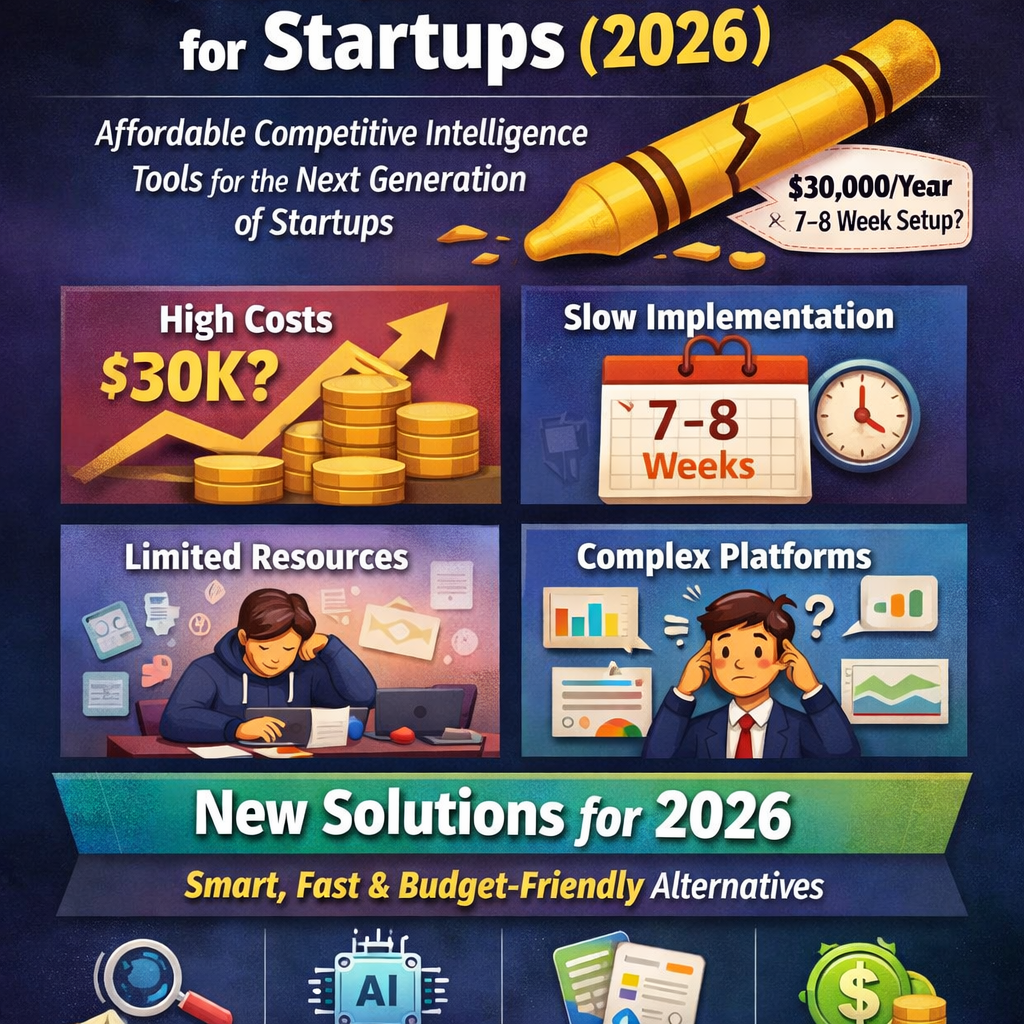
If you've been researching competitive intelligence tools, you've probably encountered Crayon. It's a powerful platform used by enterprise teams at companies like Salesforce, Drift, and Gong. But here's the reality: Crayon starts at around $30,000 per year with a 7-8 week implementation timeline. For most startups and growth-stage companies, that's simply not feasible—no matter how good the tool is.
Why Startups Are Looking for Crayon Alternatives
Crayon is an excellent tool—let's be clear about that. It offers comprehensive competitor tracking, automated battlecards, and deep market intelligence. But it's built for enterprise organizations with dedicated competitive intelligence teams and substantial budgets. Here's why startups are actively seeking alternatives:
Budget constraints are real. When you're a seed-stage or Series A startup, $30,000+ annually for a single tool represents a significant portion of your software budget. That's potentially a full-time employee, multiple marketing campaigns, or critical infrastructure investments. For many founders and product leaders, the ROI calculation simply doesn't work at that price point—especially when you're still finding product-market fit.
Implementation timelines don't match startup speed. Crayon's typical 7-8 week implementation process involves multiple stakeholders, training sessions, and configuration. Startups need to move faster. When a competitor launches a new feature or pivots their pricing, you need insights this week, not two months from now. The velocity mismatch between enterprise sales cycles and startup operational tempo creates real friction.
Resource requirements exceed team capacity. Enterprise competitive intelligence platforms often assume you have a dedicated analyst or competitive intelligence manager. Most startups don't. Your product manager is already wearing five hats, your marketing lead is juggling content and demand gen, and your founder is splitting time between fundraising and product strategy. You need tools that work autonomously, not platforms that require constant feeding and management.
Feature complexity vs. actual needs. Crayon offers extensive capabilities designed for large organizations tracking dozens of competitors across multiple markets. But if you're a B2B SaaS startup tracking 5-10 direct competitors, you don't need every enterprise feature. You need fast, actionable insights about pricing changes, feature launches, and messaging shifts—without the complexity overhead.
Top Crayon Alternatives: Detailed Comparison
1. ClientCues — Best for Budget-Conscious Startups
Pricing: Free tier available, Growth plan at $8/month
ClientCues represents a fundamentally different approach to competitive intelligence. Instead of requiring enterprise budgets and lengthy implementations, it's designed specifically for startups and growth-stage companies that need sophisticated insights without the traditional barriers to entry.
Setup time: 5 minutes. Seriously. You enter your competitors' websites or company names, and ClientCues immediately generates your first competitive intelligence report. There's no sales call requirement, no multi-week onboarding process, and no analyst training needed. You can literally start tracking competitors before your next meeting.
What you get: ClientCues monitors your competitors 24/7 across websites, social media, review sites, and Reddit. It delivers plain-English briefings every Monday morning summarizing what changed, why it matters, and what you should do about it. The AI layer doesn't just surface data—it provides strategic recommendations. When a competitor changes their pricing page, you don't just get a notification; you get analysis of how it impacts your positioning and suggested responses.
Key features include: Unlimited competitor tracking, automated weekly briefings, AI-powered topic and sentiment analysis from customer reviews and social channels, auto-generated battlecards that update automatically, instant report exports in PDF and PowerPoint formats, and real-time alerts for significant competitor moves. The platform also includes session recording capabilities that let you see how users interact with competitor websites, providing UX and conversion insights.
Best for: B2B SaaS startups tracking 3-10 competitors, product managers building roadmaps based on market gaps, marketing teams developing positioning and messaging, sales teams needing updated battlecards, and founders making strategic decisions without dedicated analyst resources.
Limitations: ClientCues doesn't offer enterprise SSO or complex compliance features (yet), and it's not designed for organizations tracking 50+ competitors simultaneously. If you need a dedicated analyst team managing insights for you, enterprise platforms might be more appropriate.
2. Klue — Enterprise Alternative with Robust Features
Pricing: $20,000-$40,000+ per year
Klue is Crayon's closest competitor in the enterprise space. It's a comprehensive competitive enablement platform used by companies like Shopify, Zuora, and Coupa. Klue emphasizes competitive battlecards, win-loss analysis, and sales enablement.
Setup time: 6-8 weeks. Similar to Crayon, Klue requires significant implementation effort. You'll work with their team to configure data sources, train users, and establish workflows. The platform is powerful but assumes you have dedicated resources to manage it.
What you get: Klue offers competitive battlecards with automatic updates, win-loss analysis integration, news and social media monitoring, internal collaboration features for sharing competitive intel, and Salesforce integration for sales enablement. The platform emphasizes turning competitive intelligence into revenue by arming sales teams with the right information at the right time.
Best for: Mid-market to enterprise B2B companies with dedicated competitive intelligence or product marketing teams, organizations where sales enablement is the primary competitive intelligence use case, and companies already using Salesforce extensively.
Limitations: Pricing puts Klue out of reach for most startups. The platform also requires ongoing management and curation—it's not a "set it and forget it" solution. Implementation timelines mean you won't see value for several months after purchase.
3. Kompyte — Mid-Market Competitive Intelligence
Pricing: $10,000-$25,000+ per year (estimated)
Kompyte (now part of Semrush) focuses on automated competitor tracking with an emphasis on digital marketing intelligence. It monitors competitor websites, content, ads, SEO changes, and social media activity.
Setup time: 3-4 weeks. Kompyte's implementation is somewhat faster than Crayon or Klue, but still requires configuration and training. You'll need to define which competitors to track, set up alerts, and configure dashboards.
What you get: Automated website change tracking, digital ad monitoring across platforms, SEO and content tracking, social media monitoring, email alerts for competitor changes, and integration with the broader Semrush ecosystem if you're already a customer.
Best for: Marketing-focused teams that need competitive intelligence primarily for digital strategy, companies already using Semrush for SEO and wanting to add competitive intelligence, and organizations with $10K+ budgets but not quite at the $30K+ enterprise level.
Limitations: Kompyte is heavily marketing-focused, which means product teams and sales teams might find it less useful than dedicated competitive intelligence platforms. Pricing is still prohibitive for early-stage startups, and the Semrush acquisition has created some uncertainty about the product's future direction.
4. Semrush Competitive Intelligence Toolkit
Pricing: $119-$449/month (part of broader Semrush subscription)
Semrush offers competitive intelligence features as part of its comprehensive digital marketing platform. If you're already a Semrush customer for SEO and content marketing, the competitive intelligence add-ons provide good value.
Setup time: 1-2 hours. Semrush's competitive tools are relatively quick to configure since they're built into the existing platform. You select competitors and the system starts tracking immediately.
What you get: Competitor SEO analysis, content gap identification, backlink comparison, paid advertising intelligence, social media tracking, and traffic analytics. Semrush excels at digital marketing intelligence but is less comprehensive for product features, pricing changes, or sales enablement.
Best for: Marketing teams already using Semrush for SEO, content marketers identifying topic opportunities, digital marketing agencies managing multiple clients, and companies where competitive intelligence is primarily about online visibility and traffic.
Limitations: Semrush's competitive intelligence is marketing-specific. It won't help your product team understand competitor feature launches or your sales team prepare for objection handling. The platform also doesn't provide the strategic "so what" layer—you get data, but interpreting it requires expertise.
5. Owler — Free Competitor Tracking with Limitations
Pricing: Free tier available, Pro at $420/year
Owler provides basic competitor tracking and news monitoring at an accessible price point. It's popular among startups because of its free tier and simple interface.
Setup time: 15 minutes. Owler is quick to set up—you create an account, add competitors, and start receiving news alerts. The simplicity is appealing but reflects the tool's limited capabilities.
What you get: Company news aggregation, basic competitor profiles, funding and acquisition tracking, email alerts for competitor news, and a simple mobile app for staying updated on the go.
Best for: Very early-stage startups with zero budget, founders who want basic competitor news without sophisticated analysis, and teams using Owler as a supplement to more robust tools.
Limitations: Owler provides news aggregation, not intelligence. You'll see that a competitor raised funding or hired a new executive, but you won't get strategic analysis of what it means or what you should do about it. There's no automated battlecard generation, no sentiment analysis, and no deep feature comparison capabilities. It's a starting point, not a complete solution.
Detailed Pricing Comparison Table
Here's how these platforms stack up financially, with setup time and key differentiators:
| Platform | Annual Cost | Monthly Equivalent | Setup Time | Best For | Key Limitation | |
|---|---|---|---|---|---|---|
| Crayon | ~$30,000+ | ~$2,500+ | 7-8 weeks | Enterprise teams with dedicated CI analysts | Price and implementation time | |
| Klue | $20,000-$40,000+ | ~$1,667-$3,333+ | 6-8 weeks | Enterprise sales enablement focus | Requires ongoing management | |
| Kompyte | $10,000-$25,000+ | ~$833-$2,083+ | 3-4 weeks | Marketing-focused competitive intelligence | Marketing-specific, less product insight | |
| Semrush CI | $1,428-$5,388 | $119-$449 | 1-2 hours | Existing Semrush customers, marketing teams | Digital marketing only, no strategic analysis | |
| Owler | Free-$420 | Free-$35 | 15 minutes | Very early-stage startups | News aggregation only, no deep intelligence | |
| ClientCues | Free-$96 | Free-$8 | 5 minutes | Startups needing full CI without enterprise cost | Not for 50+ competitors or enterprise compliance |
Feature Comparison: What Actually Matters for Startups
Beyond pricing, the feature set determines whether a competitive intelligence tool will actually get used by your team. Here's what matters most for startups:
Automated competitor monitoring is table stakes. You need tools that watch competitors 24/7 without manual checking. Crayon, Klue, Kompyte, and ClientCues all offer this. Semrush and Owler provide limited automation focused on specific channels.
AI-powered insight generation separates data dumps from actionable intelligence. ClientCues excels here by providing plain-English explanations of what changed and what to do about it. Crayon and Klue offer some AI analysis but often require analyst interpretation. Semrush and Owler provide raw data without strategic recommendations.
Battlecard generation matters enormously for sales teams. Crayon and Klue are strong here, with comprehensive battlecard builders. ClientCues auto-generates battlecards that update automatically as competitors change. Kompyte, Semrush, and Owler don't focus on sales enablement.
Setup and time-to-value is critical for startups. ClientCues delivers insights in 5 minutes. Semrush takes hours. Kompyte requires weeks. Crayon and Klue need months. When you're moving fast, implementation time directly impacts ROI.
Ease of use without dedicated resources determines adoption. If your product manager needs to spend 10 hours per week managing the tool, it won't get used. ClientCues is designed to work autonomously. Enterprise platforms assume you have someone managing them full-time.
Real-World Use Cases: When to Choose Each Alternative
Choose ClientCues if: You're a B2B SaaS startup or growth-stage company with 3-10 primary competitors. Your team includes founders, product managers, marketers, and sales people who all need competitive intelligence but nobody has "competitive analyst" in their title. Budget is a real consideration—you can't justify $20K+ annually for a single tool. You need setup measured in minutes, not months. You want AI to tell you what to do, not just what happened. This is 80% of startups reading this post.
Choose Klue if: You're a mid-market or enterprise B2B company with a dedicated product marketing or competitive intelligence team. Sales enablement is your primary competitive intelligence use case—you need sophisticated battlecards integrated deeply into your sales process. You have the budget ($20K-$40K+) and can wait 6-8 weeks for implementation. You're already using Salesforce extensively and need tight integration.
Choose Kompyte if: Your competitive intelligence needs are primarily marketing-focused. You care most about competitor SEO, content strategy, digital ads, and social media. You have $10K-$25K budget but not quite $30K+. You're willing to invest 3-4 weeks in setup for marketing-specific intelligence.
Choose Semrush CI if: You're already a Semrush customer for SEO and content marketing. Your competitive intelligence needs are 90% about digital marketing performance. You have in-house expertise to interpret data and turn it into strategy. You want to add competitive intelligence without buying a separate platform.
Choose Owler if: You're a pre-seed or bootstrapped startup with literally zero budget for competitive intelligence. You want basic news alerts about competitors without any sophisticated analysis. You understand you're getting news aggregation, not strategic intelligence, and that's acceptable for your current stage.
Making the Decision: Key Questions to Ask
When evaluating Crayon alternatives, ask yourself these questions to clarify which tool fits your needs:
What's our actual budget? Be honest. If you have less than $5,000 annually for competitive intelligence, enterprise platforms aren't realistic regardless of features. ClientCues or Semrush make more sense. If you have $20K+, Klue or Crayon become viable.
Who will manage this tool day-to-day? If the answer is "nobody specifically," you need a tool that works autonomously like ClientCues. If you have a dedicated competitive intelligence analyst, enterprise platforms make sense.
What's our primary use case? Sales enablement suggests Klue. Marketing intelligence points to Kompyte or Semrush. Product strategy and cross-functional intelligence suggests ClientCues or Crayon.
How fast do we need to move? If you need insights next week, only ClientCues or Semrush work. If you can wait 2-3 months for full implementation, enterprise options are feasible.
How many competitors do we track? 3-10 competitors? Any tool works. 10-25? You need robust platforms like ClientCues, Crayon, or Klue. 50+? Only enterprise platforms can handle that scale.
The Bottom Line: Best Crayon Alternative for Most Startups
After analyzing pricing, features, setup time, and real-world use cases, ClientCues emerges as the best Crayon alternative for most startups in 2026. Here's why:
The pricing is startup-friendly. At $8/month for the Growth plan (or free for basic needs), ClientCues costs 375 times less than Crayon annually while delivering similar core intelligence capabilities. That's not a typo—$96/year vs. $30,000+/year. For bootstrapped founders and lean teams, this difference is make-or-break.
The setup time matches startup velocity. Five minutes from signup to your first competitive intelligence report means you can start making better decisions today, not in Q3 after a lengthy implementation. When a competitor launches a new feature, you need to respond this week. ClientCues makes that possible.
The AI layer provides strategic value, not just data. You don't get a notification that a competitor changed their pricing page—you get analysis of how it impacts your positioning and what you should do about it. This "so what" layer is what startups need most, since you don't have dedicated analysts interpreting raw data.
The tool works autonomously. Your Monday morning briefing arrives automatically. Battlecards update themselves. Sentiment analysis happens in the background. Nobody needs to spend 10 hours per week managing the platform. For teams where everyone wears multiple hats, this autonomy is essential.
That said, ClientCues isn't for everyone. If you're a large enterprise with complex compliance requirements, dedicated competitive intelligence teams, and $30K+ budgets, Crayon or Klue might be better fits. If your needs are purely marketing-focused and you're already a Semrush power user, their competitive intelligence toolkit could suffice.
But for the vast majority of B2B SaaS startups, scale-ups, and growth-stage companies reading this post, ClientCues delivers the competitive intelligence you need at a price that makes sense, with setup measured in minutes instead of months.
Get Started: Try ClientCues Free
The best way to evaluate any competitive intelligence tool is to actually use it. ClientCues offers a completely free tier with no credit card required—you can generate your first competitive intelligence report right now and see how it compares to what you're doing manually today.
Here's what to do next: Go to clientcues.com and enter your top competitor's website or company name. In about 5 minutes, you'll have a comprehensive competitive intelligence report including feature comparison, pricing analysis, customer sentiment from reviews and social media, market positioning insights, and AI-generated strategic recommendations. Export it as a PDF or PowerPoint and share it with your team.
If the free report provides value, upgrade to the Growth plan for $8/month to track unlimited competitors with automated weekly briefings. No annual contract, no sales calls, no 8-week implementation. Just instant competitive intelligence that helps you make better strategic decisions.
The competitive intelligence landscape has changed. You no longer need enterprise budgets and dedicated analyst teams to understand what your competitors are doing and how to respond. Tools like ClientCues have democratized access to sophisticated market intelligence—making it available to startups at prices that actually make sense.
Stop finding out about competitor updates from your own customers. Start your free competitive intelligence report today and see what you've been missing.
Instantly compare features and user sentiment across your market. Get a competitor snapshot with real feedback and web proof—free.